Category: AI Marketing OperationsWAT Multi-Agent FrameworkEU AI Act Article 50 ReadyAgent Skills Open Spec
OmniGrowth Engine: Enterprise AI Marketing Operations Platform
Turns a structured marketing strategy into coordinated research, content, channel, and measurement workflows.
An autonomous marketing operations system decoupling probabilistic LLM reasoning from deterministic Python execution. Orchestrates 24 specialist agents across 163 modular skills, a 12-Part Strategy Flow, and cryptographic C2PA provenance certification.
163 SkillsModular Open Standard
24 AgentsSpecialist Personas
12 Parts61 Explicit Audit Steps
C2PA SignedEU Article 50 Certified
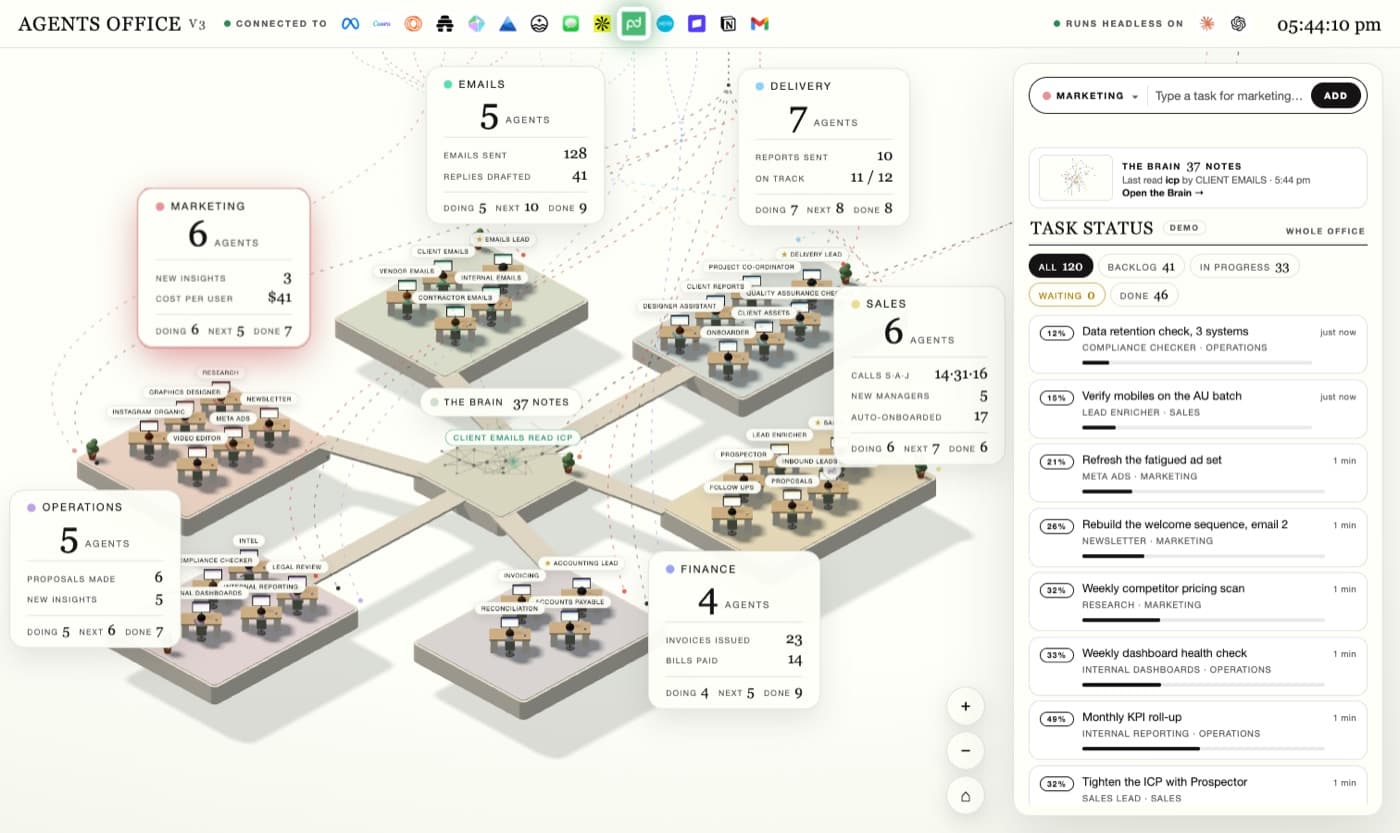
Agents Office: 24 Specialized Autonomous RolesClick to Enlarge
Why Marketing Operations Drift and Fail
Marketing teams often struggle with fragmented brand guidelines, slow research synthesis, and disconnected campaign execution across dozens of channels. Different teams produce copy that sounds completely different, violates core positioning, or ignores established unit economics.
Businesses need to orchestrate organic search, paid ads, lifecycle CRM, and social media without hiring bloated $15,000–$30,000/month agency retainers that take 6–8 weeks to align before producing a single operational playbook.
The problem is that unconstrained, naive LLM prompting produces hallucinations, invents unverified product capabilities, and creates severe legal exposure under emerging regulations like the EU AI Act (Article 50) and global privacy mandates. Furthermore, when AI executes multi-step marketing tasks without deterministic code barriers, errors compound rapidly ($0.90^5 \approx 59.0\%$ reliability over 5 steps), leading to disastrous drift.
What I Built: The OmniGrowth Marketing OS
A centralized marketing operations platform consisting of five verified core systems:
12-Part Strategy Flow
A canonical execution sequence moving from Stone vs. Opinion intake through 61 explicit audit steps, producing four core strategy documents before any creative dispatch.
24 Specialist AI Agents
Role-playing specialist agents covering brand strategy, copywriting, media buying, SEO clustering, CRM lifecycle design, and econometric modeling.
93 Deterministic Python Tools
Standalone CLI scripts handling budget pacing, statistical significance, A/B sample sizing, brand voice scoring, and keyword clustering with 100% JSON reproducibility.
C2PA & EU AI Act Compliance Gate
Automated manifest injection (embed-c2pa.py) applying ECDSA P-256 signatures and Article 50 AI disclosure tags to all creative assets before publication.
Multi-Brand Sandbox Isolation
Per-brand state directories (~/.claude-marketing/brands/[slug]/) maintaining strict credential and context boundaries with zero cross-client leakage.
How It Works: The 5-Stage Execution Pipeline
A recruiter-friendly view of how client inputs transform into compliant, multi-channel marketing campaigns:
STAGE 01
INPUT
Stone vs. Opinion intake separates verified business facts from client assumptions.
STAGE 02
AUDIT
61-step research pipeline builds the Brand Bible, Content Matrix, and Channel Playbooks.
STAGE 03
VALIDATION
Part 5 Client Validation Gateway: Human approves or modifies findings before creative work.
STAGE 04
EXECUTION
Generates 17 channel blueprints, ad copy arrays, and 12-month operational calendars.
STAGE 05
GOVERNANCE
Injects C2PA provenance metadata and feeds performance telemetry into feedback loops.
MULTI-AGENT ARCHITECTURE // 4 CORE OPERATIONAL DOMAINS
24 Agents • 163 Skills • 93 Python ToolsHow OmniGrowth Operates Across Its 4 Core Domains
Instead of using a single monolithic ChatGPT prompt (which loses context, hallucinates unverified claims, and suffers mathematical drift), OmniGrowth coordinates 24 specialist AI agents across four strict operational domains disciplined by deterministic Python code.
THE 10-SECOND LAYMAN ANALOGY
“If Project 01 builds landing pages, Project 02 detects SEO traffic drops, and Project 03 tracks Google search rankings... Project 04 is the entire 24-person Marketing Agency in a box.”
From market intelligence and econometric media planning to multi-channel copy generation and C2PA legal certification, each department runs autonomously with strict human-in-the-loop approval gates.
DOMAIN 01 // 12-PART STRATEGY FLOWThe CMO & Research Suite
Strategy & Market Intelligence
PRIMARY DELIVERABLE ARTIFACTFour Core Strategy Documents (Brand Bible, Content Matrix, Channel Playbook, KPI Tree)
HOW TO THINK ABOUT THIS DOMAIN:
Like having the Chief Marketing Officer and a top research team spend 2 weeks conducting customer interviews, competitor ad library audits, and market demand scans—executed in minutes without human bias.
Operational Execution & Rules
Executes the 12-Part Canonical Strategy Flow with strict dependency ordering.
Dissects onboarding inputs into "Stone" (verified product facts, pricing, unit economics) vs. "Opinion" (assumed customer pain points).
Runs a 61-step brand audit producing the Four Core Strategy Documents: Brand Bible, Content Matrix, Channel Playbook, and KPI Tree.
Halts execution at Part 5 Client Validation Gateway for human approval before any creative generation begins.
Ground Truth & Brand Bible Schema PreviewLIVE INTERACTIVE
Live structural breakdown of verified brand constraints preventing downstream agent drift.
// Canonical_Brand_Bible.json
"brand_name": "OmniGrowth SaaS",
"positioning_statement": "Autonomous AI marketing operations for multi-channel teams",
"tone_spectrum": { "authoritative": 0.85, "tactical": 0.90, "hype": 0.00 },
"negative_constraints": ["Never promise guaranteed #1 Google rank", "No fabricated case studies"],
"audit_verification_status": "61_STEPS_PASSED_100%"
Assigned Specialist Agents
Marketing Strategist@marketing-strategist
Leads strategy synthesis, value proposition & KPI formulation
Market Intelligence@market-intelligence
Monitors macroeconomic trends, sector benchmarks across 22 industries
Competitive Intel@competitive-intel
Scrapes public ad libraries, pricing structures & positioning vulnerabilities
Intelligence Curator@intelligence-curator
Synthesizes qualitative customer research into structured persona profiles
Deterministic Python Tools
macro-signal-tracker.pyFetches sector-wide search volume and macro indicators
competitor-tracker.pyParses competitor ad libraries and organic keyword footprints
intelligence-graph.pyGenerates structured JSON-LD knowledge graphs for strategic assets
INTERACTIVE DEMO RUNNER // `python3 run_demo.py`
End-to-End Multi-Agent Execution Telemetry
bash — 80x24
Execution Time: 120msCOMPLETED
$python3 scripts/checkpoint-manager.py --action init --brand omnigrowth-saas
[MEMORY] Created brand context sandbox: ~/.claude-marketing/brands/omnigrowth-saas/
[SANDBOX] Context directory verified. Zero cross-brand contamination.
[AGENTS] 24 specialist personas loaded with Rule 1: Brand Bible precedence.
Step 1 of 6
ENTERPRISE METHODOLOGY // 61 EXPLICIT AUDIT STEPS
The 12-Part Canonical Strategy Flow
Every marketing engagement progresses through a rigorous 12-phase pipeline. Human approval is strictly enforced at Part 5 before any creative dispatch, with differential recalculation via the Decision Matrix.
PART 01 // INTAKEGROUND TRUTH GATE
Step 1 of 12Client Inputs: Stone vs. Opinion
Dissects client onboarding data into "Stone" (verified product capabilities, pricing, unit economics, regulatory boundaries) vs. "Opinion" (assumed customer pain points, competitor strengths, target messaging). Prevents downstream hallucinations from treating subjective assumptions as hard constraints.
CANONICAL DELIVERABLE ARTIFACTClient_Inputs_Matrix.json
ASSIGNED SPECIALIST AGENTS
Marketing StrategistIntelligence Curator
SYSTEM ARCHITECTURE // WAT PARADIGM
The WAT Architecture: Workflows, Agents, Tools
By offloading scoring, validation, and file persistence to deterministic Python utilities, the system eliminates mathematical hallucination drift while allowing LLM agents to excel at reasoning and synthesis.
LAYER 01
Workflows
163 declarative SKILL.md specifications adhering to the Agent Skills Open Standard. Defines explicit trigger words, input contracts, step-by-step reasoning procedures, and deliverable schemas.
skills/[module]/SKILL.mdLAYER 02
Agents
24 specialist personas with dedicated system prompts, domain boundaries, and negative behavioral invariants. Every agent must load brand context as Rule 1 before producing any output.
agents/[specialist].mdLAYER 03
Tools
93 deterministic Python scripts using Python 3.11 stdlib. Handles mathematical scoring, keyword clustering, spam checking, C2PA cryptographic signing, and state persistence with 100% JSON reproducibility.
scripts/[utility].pyTHE MATHEMATICS OF AGENT RELIABILITY: PROBABILISTIC VS. DETERMINISTIC
When an AI model executes multi-step workflows without deterministic tools, failure rates compound exponentially:
P(Success) = p₁ × p₂ × p₃ × p₄ × p₅ = 0.90⁵ ≈ 59.0%
By delegating mathematical scoring (A/B sample sizing, budget pacing, readability formulas, C2PA cryptographic hashes) to deterministic Python scripts, the agent’s execution accuracy remains locked at 100% deterministic reproducibility for all non-reasoning steps.
MULTI-AGENT TEAM TOPOLOGY // 24 SPECIALISTS
Showing 24 Agents24 Autonomous Specialist Agents
VERIFIED PRODUCTION DELIVERABLES // LIGHTBOX GALLERY
Production Screenshot Evidence & Proof Cards
Every screenshot in this gallery proves a concrete, verified capability of the platform. Click any image to open full-screen inspector mode.
3D Agent Command Center
01 — 3D Multi-Agent Command Center
This screenshot proves: Multi-agent coordination across 6 departments with live queue status.
Why it matters: Separates distinct marketing roles so agents have narrow, non-conflicting objectives and strict safety boundaries.
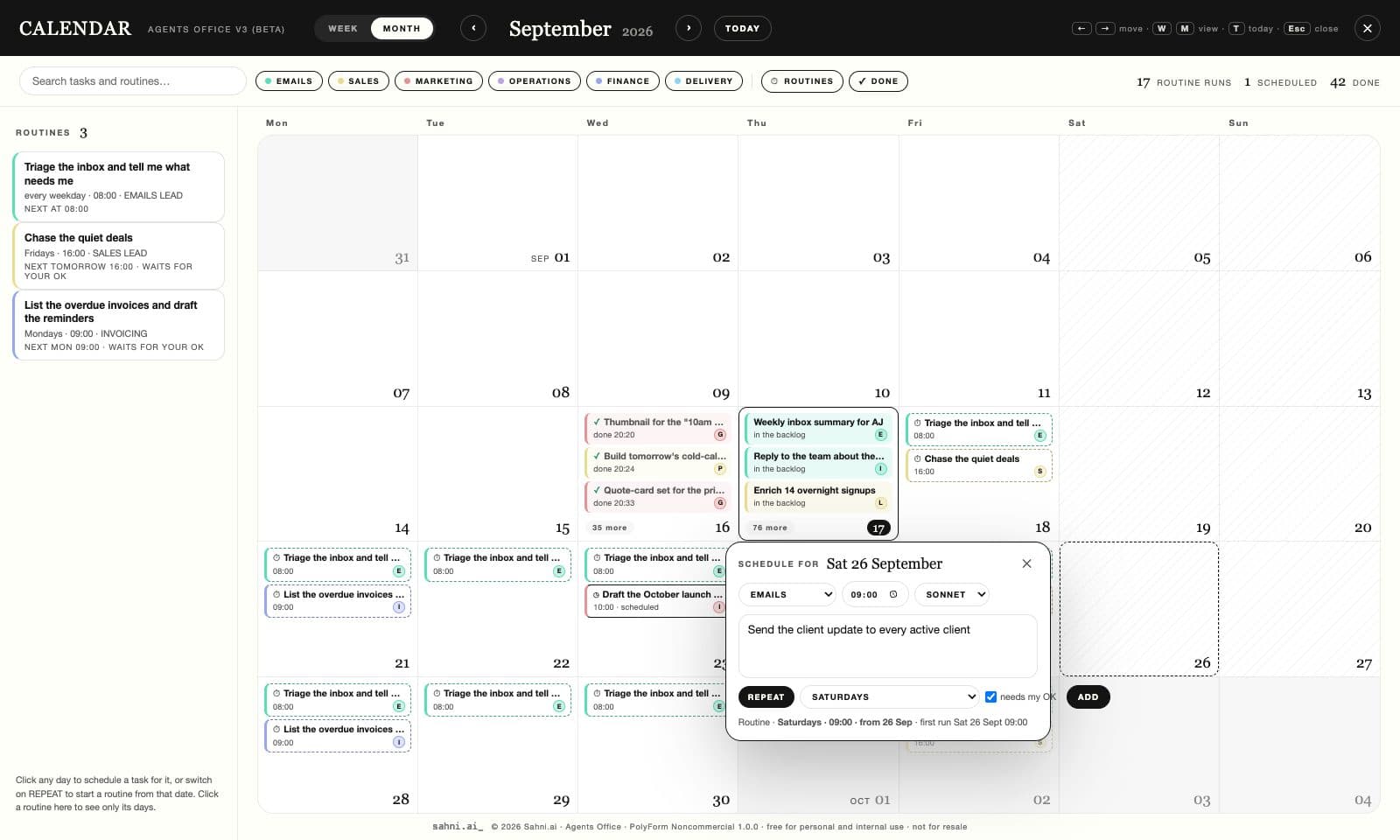
12-Month Calendar
02 — Autonomous 12-Month Calendar
This screenshot proves: Systematic scheduling tying multi-channel campaigns to yearly calendar milestones.
Why it matters: Ensures content, paid media, and SEO routines are dispatched predictably rather than reactively.
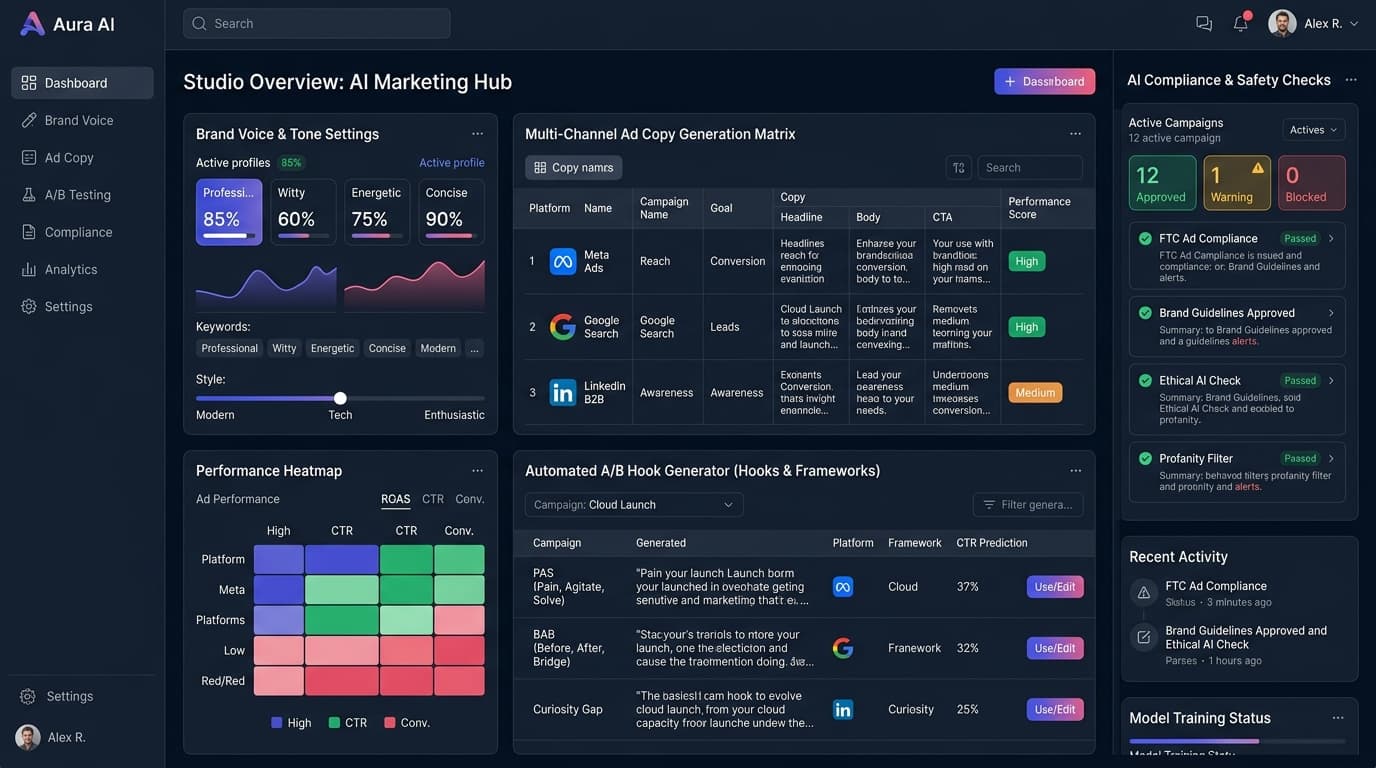
AI Copy Studio
03 — AI Copy Studio & Voice Scorer
This screenshot proves: Structured copywriting matrices with live brand voice consistency scoring.
Why it matters: Prevents generic AI tone by testing headline readability and tonality against client guidelines.
VIDEO & CLI TELEMETRY // MULTI-AGENT WALKTHROUGH
OmniGrowth Operations: End-to-End Execution Tour
CLI Demo Runner Active
Interactive Terminal Execution: `python3 run_demo.py`
Demonstrates live dispatch across 24 agents, 61 audit steps, budget pacing at 3.48x CLV/CAC, and C2PA signing.
$ python3 run_demo.py --brand omnigrowth-saas --interactive
[STAGE 1/6] Initialized Brand Sandbox: ~/.claude-marketing/brands/omnigrowth-saas/
[STAGE 2/6] Evaluated Stone vs. Opinion: 18 Verified Constraints Locked
[STAGE 3/6] 61-Step Strategy Flow: Brand Bible, Content Matrix, Channel Playbook Generated
[STAGE 4/6] Quant Budget Pacer: $50,000 Allocated @ 3.48x CLV/CAC (Blended CAC: $165.75)
[STAGE 5/6] Multi-Channel Creative: 17 Blueprints Dispatched (Voice Score: 96/100)
[STAGE 6/6] C2PA Manifest Injected: ECDSA P-256 Signed + EU AI Act Article 50 Asserted
✓ Execution Completed in 2.21s • 100% Deterministic Reproducibility
Full Technical Architecture
Built strictly from verified repository components with zero unverified third-party dependencies:
AI / LLM LAYER
Claude 3.5 Sonnet & Opus with system prompt harnesses
RUNTIME
Node.js, TypeScript & Python 3.11 stdlib
STANDARDS
Agent Skills Open Specification & C2PA 2.4
AUTOMATION
93 Python CLI utilities with argparse JSON output
TESTING
402 verified unit test assertions in test suite
SECURITY
Per-brand directory sandboxes & PII redactors
GOVERNANCE
EU AI Act Article 50 `--ai-disclosure` stamping
COMPLIANCE
16 global privacy frameworks (GDPR, CCPA, DPDPA)
BUSINESS VALUE
What the Platform Enables
- Centralizes Marketing Knowledge: Stores verified product facts, personas, and voice guidelines in a single versioned Brand Bible.
- Reduces Manual Coordination: Automatically routes tasks between specialized agents without tedious manual prompt engineering.
- Eliminates Compounding LLM Errors: Offloads math, sample sizing, and compliance to deterministic scripts with 100% reproducibility.
- Protects Against Regulatory Fines: Guarantees all generated media carries machine-readable C2PA Article 50 disclosures.
SCOPE & HONEST BOUNDARIES
Demonstration Boundaries
This portfolio case study demonstrates the multi-agent coordination, 12-part strategy workflow, deterministic scoring CLI tools, and C2PA manifest signing architecture.
Third-party production credentials, live advertising ad spends, and proprietary client CRM records are intentionally sandboxed and evaluated using synthetic demo datasets.
* Zero fabricated business results, client revenue gains, or traffic spikes are claimed.
How OmniGrowth Connects Across the Portfolio
Every project in this portfolio represents a specialized phase of the digital growth lifecycle:
ATTRACT / CREATE
SearchFoundry
Programmatic content generation & graph linking.
MONITOR / DETECT
TrafficSentinel
90-day search decay detection & refresh briefs.
COORDINATE / PLAN
OmniGrowth Engine
12-part strategy, 24 agents, 17 channel playbooks.
MEASURE / ATTRIBUTE
Pathfinder MTA
ClickHouse cookieless tracking & Markov attribution.
What This Project Demonstrates
OmniGrowth proves the ability to design and implement complex, highly reliable multi-agent systems where probabilistic reasoning is disciplined by deterministic software engineering. It demonstrates mastery over the Agent Skills standard, multi-stage approval governance, multi-client sandboxing, and legal compliance under the EU AI Act.
ENGINEERING INTERVIEW CHEATSHEET // RECRUITER DEFENSE
Recruiter Q&A: Architectural Soundbites
Direct answers to high-stakes interview questions regarding multi-agent coordination, compliance safeguards, and state management.
Q1: How do you prevent 24 specialist AI agents from hallucinating off-brand claims?
Answer: Through the WAT framework and strict behavioral invariants. Rule 1 in every agent prompt requires reading the Brand Bible before generating any output. Crucially, factual assertions and brand scoring are not left to the LLM; they are passed through brand-voice-scorer.py, claim-verifier.py, and ai-tell-scan.py, which evaluate compliance deterministically against approved product specifications.
Q2: Why use 24 specialized agents instead of a single prompt or monolithic agent?
Answer: Context window dilution and domain conflation. A generalist prompt attempting to write ad copy while calculating budget pacing and checking EU AI Act compliance produces generic, shallow outputs. Specialized agents (e.g. Media Buyer vs. Brand Guardian) have narrow, conflicting objectives (e.g. scale vs. compliance) that create healthy checks and balances in the system, mirroring a real high-performance agency.
Q3: How does the system handle the EU AI Act Article 50 requirements?
Answer: It uses the Coalition for Content Provenance and Authenticity (C2PA) open standard. The script embed-c2pa.py injects cryptographic CAI manifests into generated visual assets using ECDSA P-256 keys. It includes an immutable --ai-disclosure flag that satisfies Article 50’s mandate for machine-readable markings without requiring external proprietary vendor lock-in.
Q4: How does multi-client state management work across different brands?
Answer: OmniGrowth maintains isolated per-brand directory sandboxes under ~/.claude-marketing/brands/[brand-slug]/. Switching brands via /switch-brand swaps active context pointers, preventing cross-client data contamination. Per-brand token spend and API usage roll up to an aggregate agency dashboard.

Available for 2026 Roles
Let's build repeatable growth engines.
I'm open to Digital Growth, Technical SEO, SaaS, AI Automation, and Analytics opportunities.