Supporting Case Study #11Quantitative Multi-Agent ResearchLangGraph Stateful GraphResearch Only — Not Advice
AlphaTrade: Autonomous Multi-Agent Financial Research & Decision Platform
A stateful multi-agent research framework engineered with LangGraph and Python. Coordinates 9 specialist roles—including technical analysts, news researchers, bull/bear debaters, and risk managers—to analyze multi-vendor market telemetry, evaluate counterarguments, and generate auditable simulated decisions.
OrchestrationLangGraph State Graph
Specialist Roles9 Agent Personas
Debate EngineBull / Bear Adversarial
Simulated ScopeResearch Framework
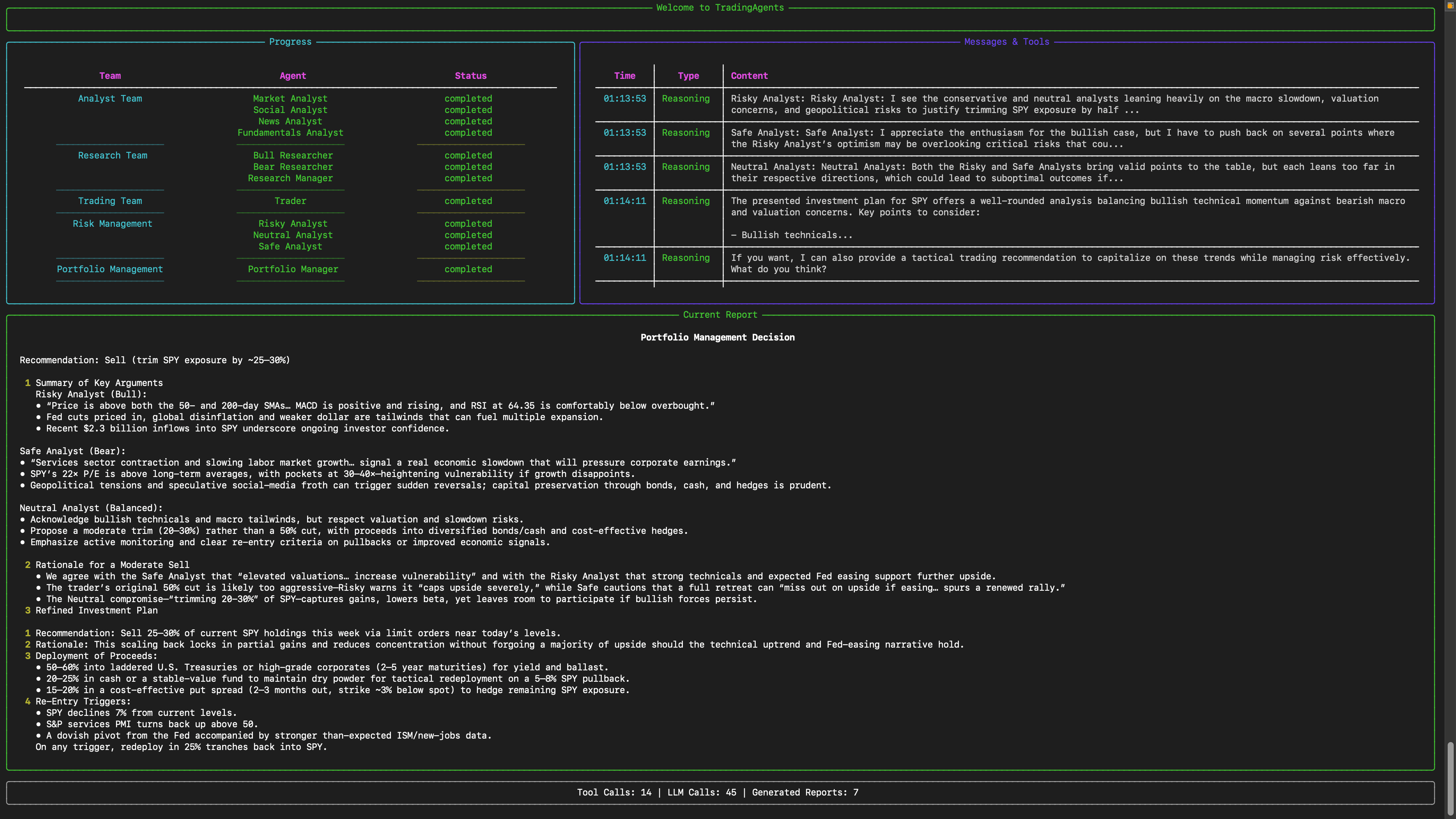
CLI Transaction Execution & Markdown Decision Log
Expand ProofThe Research Problem
Why Monolithic LLMs Fail Complex Financial Decision-Making
Confirmation Bias in Single Prompts
Querying a single LLM about an asset trend typically produces a sycophantic summary that mirrors the prompt's tone, failing to challenge assumptions with rigorous bearish counterarguments.
Unchecked Hallucinated Metrics
Without deterministic API connections to authoritative market data, language models fabricate historical prices, technical indicators, and financial ratios with high confidence.
Missing Risk Governance & Position Sizing
Standard AI trading bots recommend aggressive positions without modeling volatility, portfolio liquidity, maximum drawdown thresholds, or stop-loss mechanisms.
Non-Reproducible Decision History
Without stateful checkpoints and point-in-time timestamping, it is impossible to audit why a particular simulated decision was made or evaluate model drift across historical backtests.
The Architecture
AlphaTrade: Stateful Multi-Agent Research Desk
I engineered AlphaTrade as an open-source multi-agent research framework built on Python and LangGraph. Instead of a single model prompt, it orchestrates a formal research desk: technical and news analysts gather evidence, bull and bear researchers debate opposing theses, a trader formulates an order proposal, a risk manager checks limits, and a portfolio manager makes the final simulated decision.
LangGraph State Machine
Coordinates asynchronous node transitions and conditional routing between analyst, debate, and risk checkpoints.
Adversarial Debate
Forces opposing bull and bear personas to challenge assumptions before signals are presented to the portfolio manager.
Risk Management Gate
Evaluates position sizing, volatility boundaries, and maximum drawdown limits prior to simulated execution.
Decision Graph Flow
How It Works: From Market Feeds to Audited Decision
1
Market Context
Pulls point-in-time OHLCV, SEC, and macro data.
2
Specialist Analysts
Technical, fundamental, and sentiment reports.
3
Bull/Bear Debate
Structured adversarial debate evaluates theses.
4
Trader Proposal
Trader writes specific order size and timing.
5
Risk Team Gate
Challenges sizing and volatility boundaries.
6
Simulated Order
Portfolio manager executes and logs audit.
LangGraph State Graph Execution Trace
Python 3.10+ / LangGraph# Evaluating ticker AAPL on target date 2026-03-15
> Node [analysts]: gathering technical (RSI=48.2), sentiment (score=+0.35), news (3 articles)
> Node [bull_debater]: "Strong services revenue momentum and breakout above 50-day EMA"
> Node [bear_debater]: "Regulatory headwind in EU and valuation at 31x forward earnings"
> Node [risk_manager]: Limits proposal from 500 shares to 150 shares (max 3% portfolio risk)
> Node [portfolio_manager]: Approved simulated BUY 150 shares @ $182.40 | Checkpoint saved
Evidence Gallery
Visual Evidence & Execution Telemetry
CLI Transaction
Simulated Order Execution & Decision Log Console
Interactive terminal output showing the portfolio manager evaluating risk parameters, reviewing bull/bear analyst debates, and recording simulated trade orders into an immutable Markdown decision log.
Click for proof
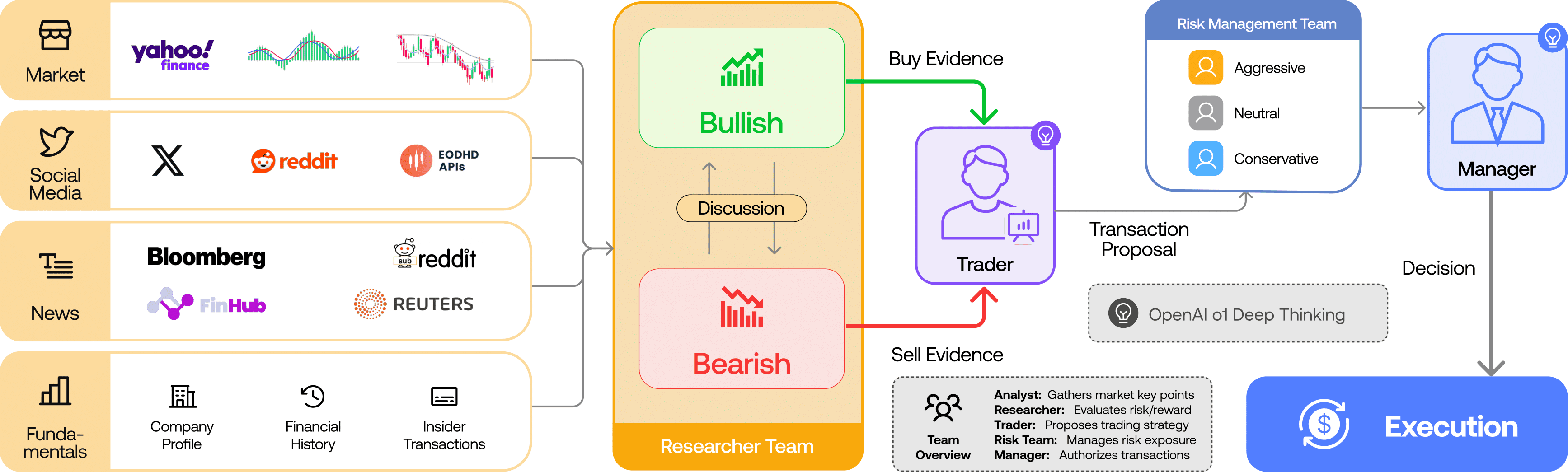
Agent Graph
LangGraph Stateful Multi-Agent Execution Schema
Architectural graph schema illustrating data flow between 9 specialized agents: Technical, Fundamentals, Sentiment, News, Bull/Bear Debate, Trader, Risk Management, and Portfolio Manager.
Click for proof
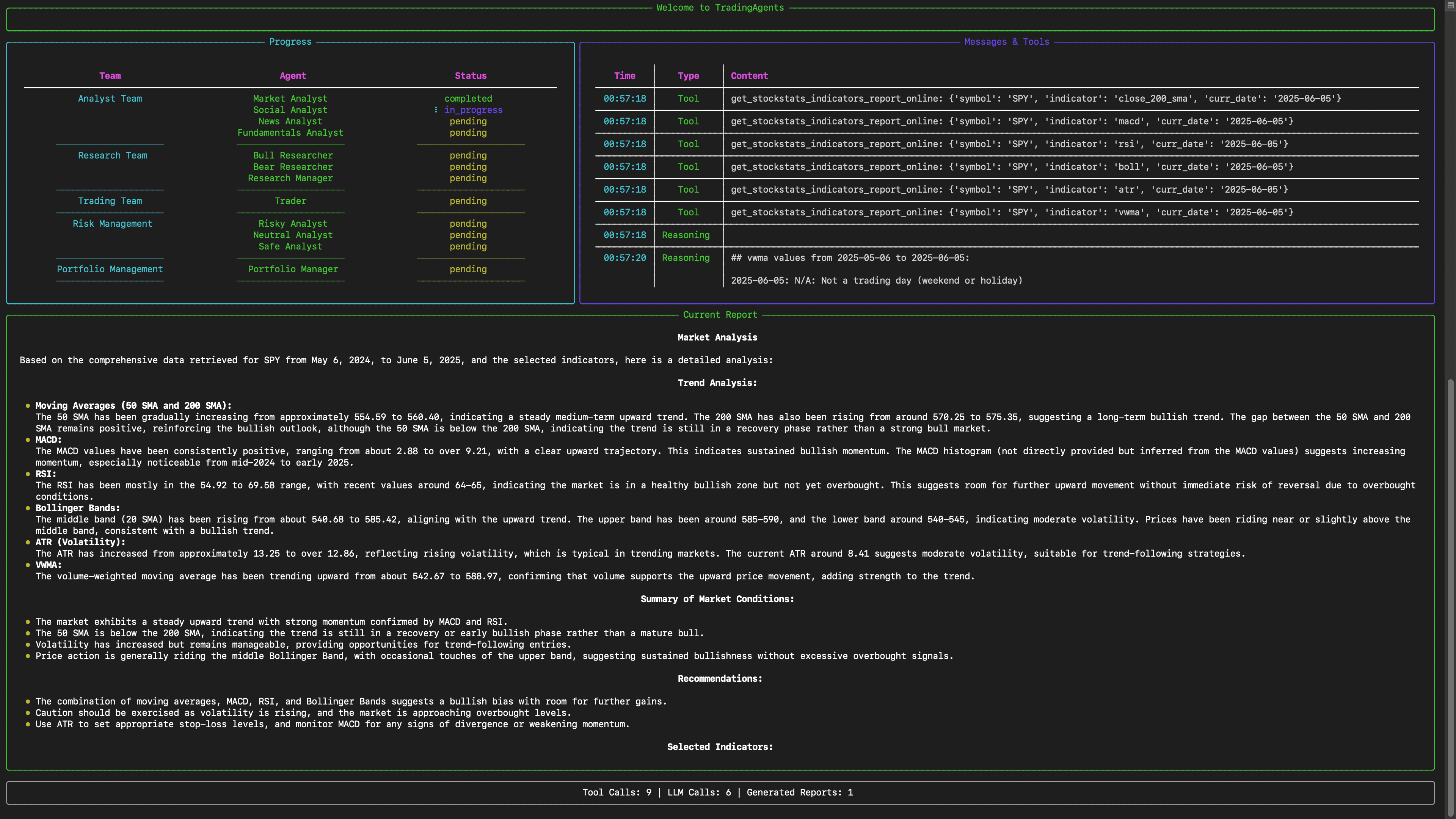
Technical Analyst
Technical Analysis & Quantitative Indicator Engine
Technical analyst agent telemetry parsing historical OHLCV data, computing MACD, RSI, Bollinger Bands, and support/resistance zones via StockStats and pandas.
Click for proof
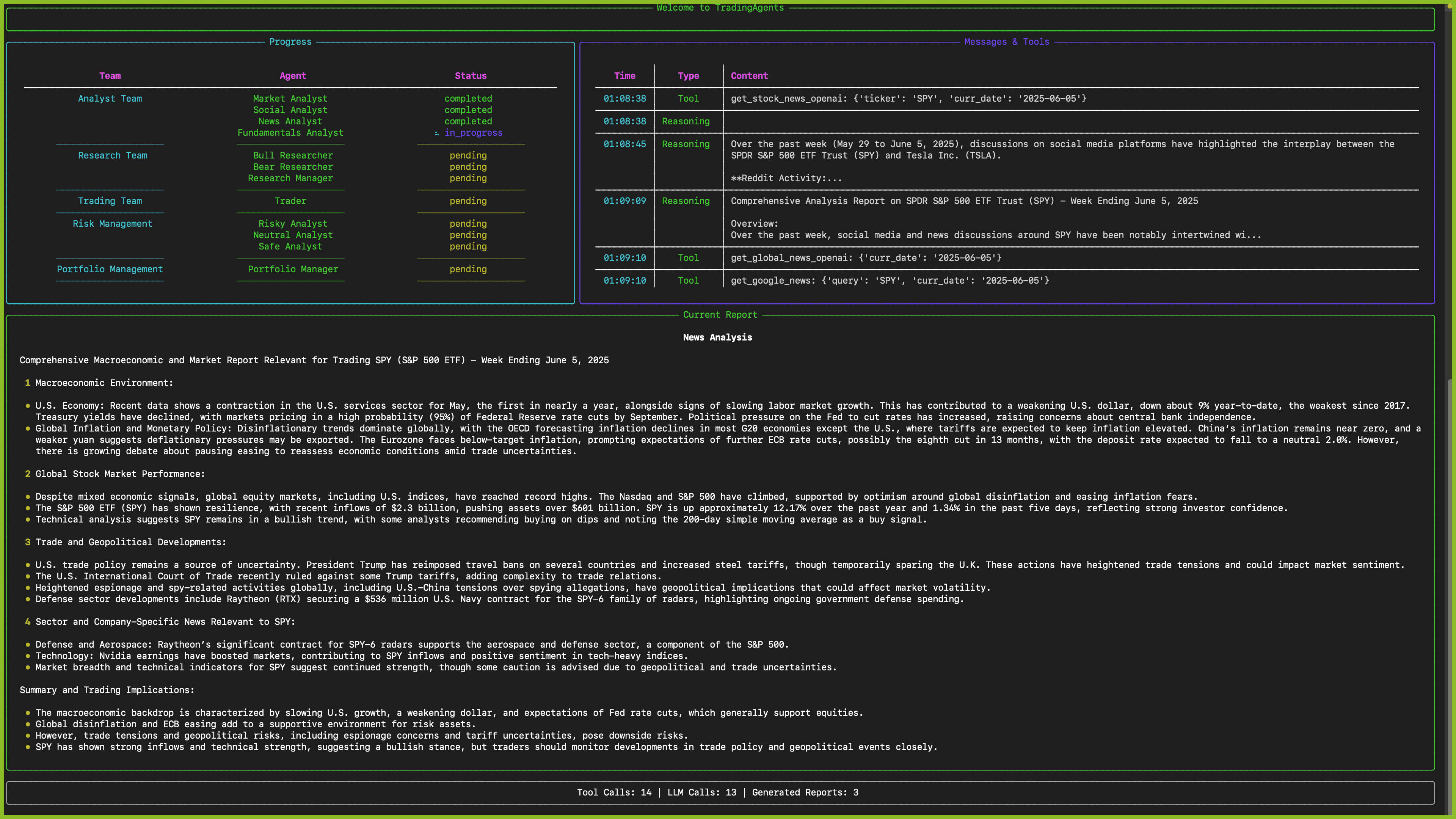
Sentiment & News
Financial News & Macro Sentiment Pipeline
Sentiment analyst scraping multi-vendor financial headlines, SEC filing summaries, and macro indicators, classifying news sentiment with confidence bounds.
Click for proof
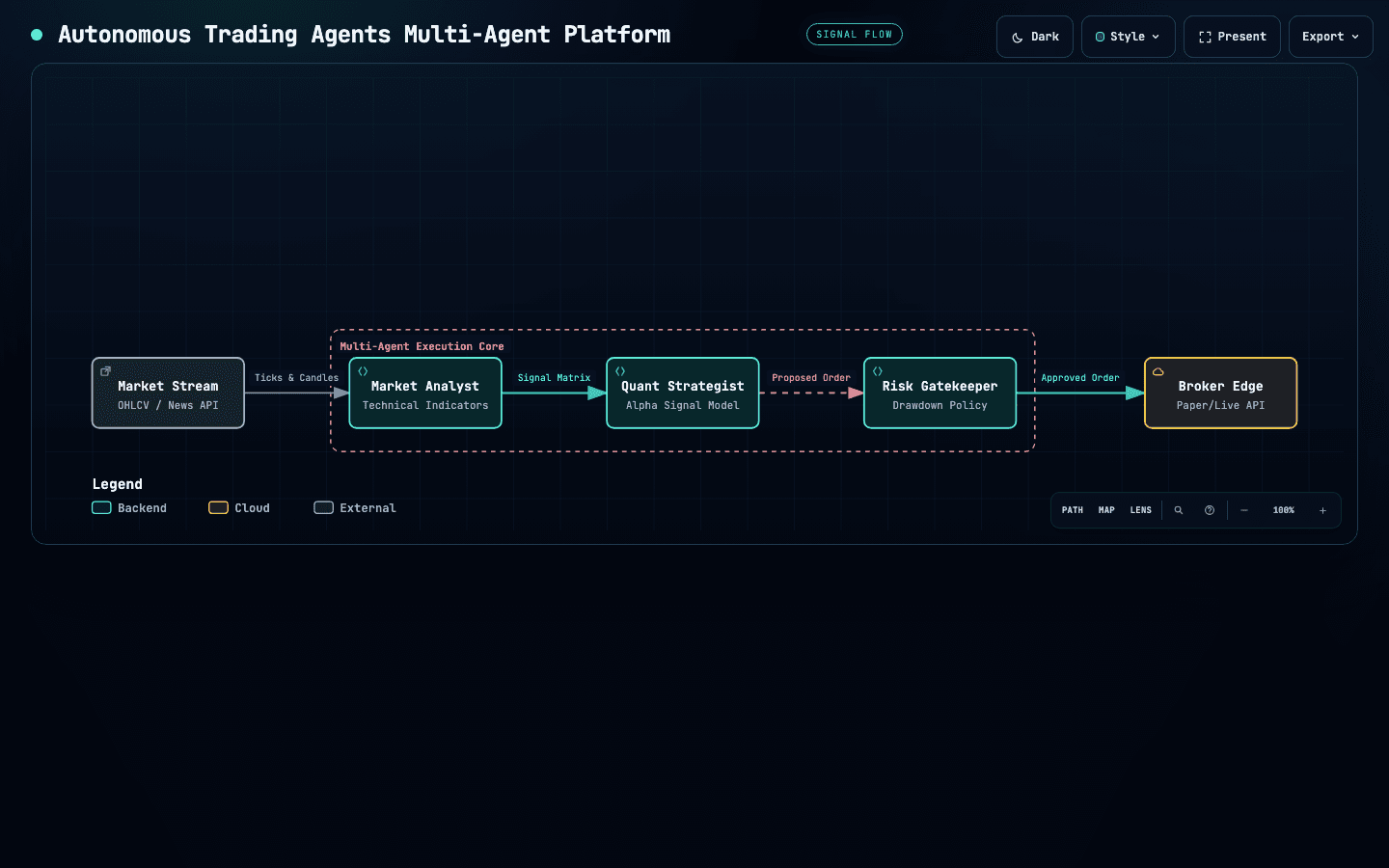
System Topology
End-to-End Decision Framework & Checkpoint Topology
Complete architectural topology showing multi-vendor data ingress (yfinance, FRED, Alpha Vantage), LangGraph state graph, SQLite checkpoint backend, and Typer/Rich CLI interface.
Click for proof
Verification & Rigor
What These Engineering Artifacts Conclusively Prove
Stateful LangGraph Agent Coordination
This proves: Replaces naive single-shot prompts with a stateful directed acyclic graph. Each agent has explicit typing, input boundaries, and conditional review edges.
Why it matters: Demonstrates real engineering mastery in multi-agent orchestration, state persistence, and error recovery.
Strict Risk & Safety Controls
This proves: Enforces dedicated risk checkpoints that can reject or downsize aggressive trader proposals before simulated execution.
Why it matters: Prevents rogue autonomous agents from taking unmitigated risks or generating unconstrained financial orders.
Framework Modules
Core Quantitative & Agentic Modules
LangGraph Multi-Agent DeskOrchestration
Stateful execution graph coordinating 9 distinct analyst, debate, risk, and portfolio roles.
Bull vs Bear Structured DebateReasoning
Dedicated adversarial researchers debate the evidence, exposing counterarguments before the trader writes a proposal.
Independent Risk Review GateRisk Governance
Risk management agents challenge the trade size, stop-loss thresholds, and volatility exposure prior to approval.
Multi-Vendor Data IngestionData Feeds
Integrates market prices, fundamentals, news, macro series (FRED), and SEC filings through unified adapters.
SQLite Checkpointing & Decision LogReproducibility
Persists intermediate agent state to SQLite and logs full conversational rationale into Markdown audit files.
Simulated Exchange ExecutionSimulation
Models portfolio balances, commissions, slippage, and cash allocations in a simulated environment.
Under The Hood
Technical Stack & Multi-Vendor Orchestration
Agent Orchestration & Data
- LangGraph & LangChain: Directed graph managing cyclical debate loops and conditional risk transitions.
- StockStats & pandas: Calculation of technical indicators (MACD, RSI, Bollinger Bands, ATR).
- SQLite Checkpointer: Serializes complete execution state at every node boundary for retrospective auditing.
CLI & Provider Integration
- Typer, Rich & Questionary: Rich terminal interface displaying live progress spinners, tables, and colored traces.
- Provider Agnostic: Adapters for OpenAI, Anthropic, Gemini, DeepSeek, Ollama, and OpenRouter.
- Markdown Decision Logger: Persists human-readable reasoning alongside structured JSON metrics.
Epistemic Rigor
Verified Repository Evidence (Strict Truth Bounds)
[FACT] Research-Only Framework: Explicitly framed as academic/research software; not investment or trading advice.
[FACT] Verified Walkthrough Video: Live demo walkthrough available at YouTube (90gr5lwjIho).
[FACT] Zero Profitability Claims: Does not claim live trading profits, win rates, or client fund management.
[FACT] Simulated Execution Only: Orders are simulated against market price feeds with zero live brokerage connectivity.
Engineering Impact
Value & Applied Learnings
Adversarial Truth-Seeking
Proves that pitting specialized agents against one another drastically curtails hallucinated assumptions.
Risk-Gated Autonomy
Demonstrates how to decouple agent proposal generation from critical safety and risk approval gates.
Auditable Reasoning
Records every debate argument and indicator calculation into permanent Markdown and SQLite logs.
Scope & Transparent Boundaries
Engineering Limitations & Scope
Research Only Disclaimer: The source code explicitly states that AlphaTrade is for quantitative research only and does not constitute financial, investment, or trading advice.
Model Non-Determinism: Model temperature and live market data feeds introduce variance across runs; backtest outcomes vary depending on provider and sampling seeds.
No Live Brokerage Execution: The platform contains zero production broker execution modules; all transactions are strictly simulated within virtual cash portfolios.
Ecosystem Position
Supporting Technical System in the Portfolio
While outside the core Digital Growth & SEO narrative, AlphaTrade demonstrates advanced multi-agent orchestration (LangGraph), stateful graph execution, adversarial debate mechanics, and strict risk governance. It proves the candidate can design resilient decision-support systems that don't blindly trust LLM outputs.
What This Demonstrates to Engineering Teams
AlphaTrade proves my ability to implement complex multi-agent frameworks using LangGraph. It highlights deep appreciation for data provenance, adversarial verification, checkpoint persistence, and safety boundary enforcement in high-concurrency Python applications.

Available for 2026 Roles
Let's build repeatable growth engines.
I'm open to Digital Growth, Technical SEO, SaaS, AI Automation, and Analytics opportunities.