Category: Web Automation & Data Extraction SaaSReact Flow DAG BuilderHeadless Browser EngineAI Schema Extraction
CrawlMindAI: Visual Web Automation & Data Extraction Studio
Turns unstructured web pages into structured JSON APIs using visual DAG workflows and AI extraction.
A visual node-based browser automation platform combining drag-and-drop React Flow pipelines, headless browser clusters, and LLM-assisted schema extraction to convert complex dynamic websites into clean, reliable JSON feeds.
18 NodesModular Task Registry
React FlowVisual DAG Pipeline
Gemini / GPTAI Schema Synthesis
Stripe CreditsUsage-Based Billing
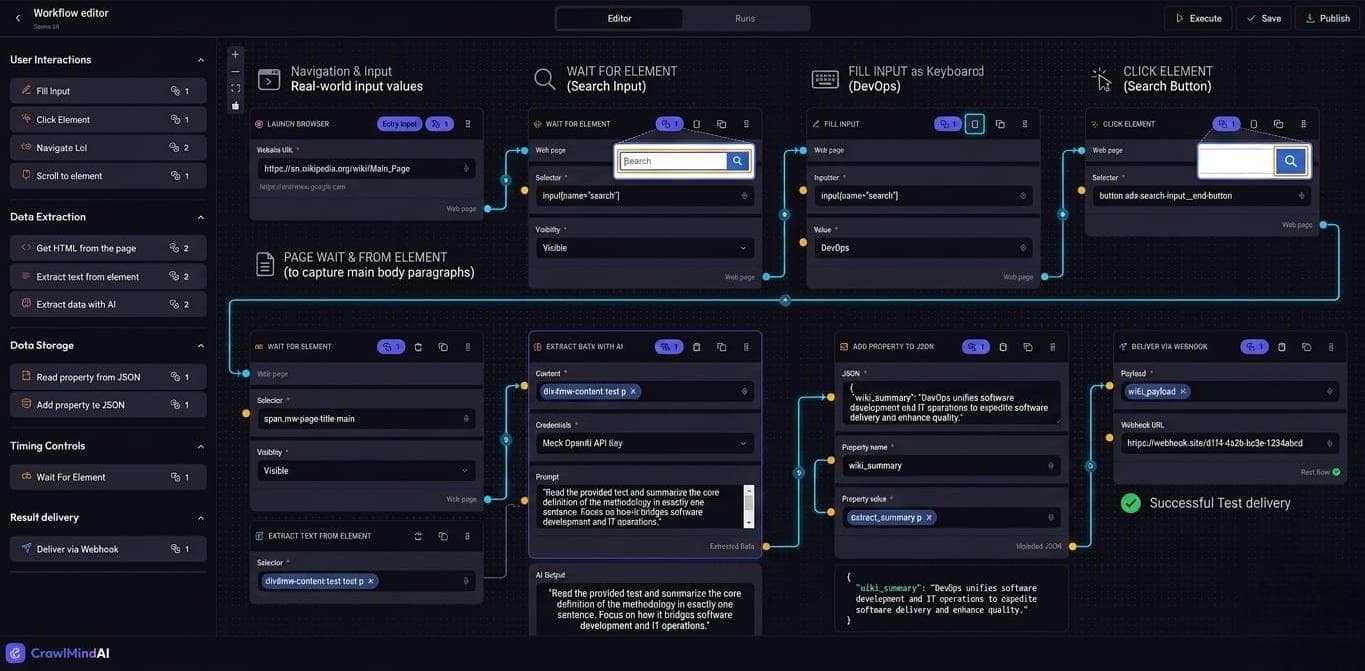
Visual Canvas: React Flow DAG Web AutomationClick to Enlarge
Why Web Scraping Scripts Constantly Break
Marketing teams and data engineers often need to extract competitive pricing, catalog availability, and market intelligence from dynamic modern web applications. Building programmatic content, tracking competitor discount shifts, or monitoring job boards requires fresh structured data feeds.
Businesses need to turn dynamic, multi-step web interactions into reliable JSON APIs without writing brittle, one-off scripts for every target domain.
The problem is that modern websites rely on complex single-page architectures (React, Vue, Next.js), infinite scroll, modal dialogs, and dynamic DOM mutations. Traditional HTML scrapers like BeautifulSoup fail completely on JavaScript-rendered content, while raw Puppeteer scripts break whenever a CSS selector changes by a single character. Engineering teams end up spending 70% of their time maintaining broken scrapers rather than utilizing data.
What I Built: The CrawlMindAI Platform
A visual web automation and structured extraction studio composed of five verified systems:
Visual React Flow Canvas
Interactive node-based DAG editor allowing drag-and-drop workflow assembly, validation connections, custom parameter inputs, and real-time execution graphs.
Headless Browser Automation
Puppeteer engine executing clicks, form input filling, infinite scroll pagination, and synchronization barriers with custom stealth headers to bypass bot blocks.
AI-Assisted Schema Parsing
Integrates Google Gemini and OpenAI to digest raw HTML fragments and output strictly validated JSON schemas, eliminating brittle CSS selector maintenance.
Direct Hydration Extraction
Extracts __NEXT_DATA__ JSON payloads and JSON-LD schema metadata directly from script tags, retrieving raw data without triggering expensive DOM rendering.
Phase Telemetry & Credit Billing
Tracks phase-by-phase execution logs, node status timestamps, credit consumption costs, and Stripe billing pack integration backed by PostgreSQL (Prisma).
How It Works: Web Task to Structured Result
A simple visual breakdown of how unstructured web interfaces are transformed into structured API payloads:
STEP 01
TASK
User visually connects nodes in React Flow to define target URLs and scraping goals.
STEP 02
BROWSER
Puppeteer launches headless Chromium, navigates to target, and injects stealth headers.
STEP 03
INTERACT
Simulates human clicks, fills form filters, and scrolls to trigger dynamic content loads.
STEP 04
AI EXTRACT
LLM parses target HTML fragments and synthesizes strict, typed JSON schemas.
STEP 05
DELIVER
Validates JSON structure and delivers data payload via HTTP POST to user webhook.
NODE REGISTRY // 18 VERIFIED TASKS
Showing 18 Task NodesModular Task Nodes Directory
VERIFIED PRODUCTION DELIVERABLES // LIGHTBOX GALLERY
Production Screenshot Evidence & Proof Cards
Every visual proves a verified capability of the platform. Click any asset to inspect in full-resolution modal.
Visual DAG Builder
01 — Visual DAG Workflow Builder
This screenshot proves: React Flow visual graph assembly with node execution handles.
Why it matters: Eliminates the need to write custom Python scripts for routine scraping tasks.
Competitor Pipeline
02 — Competitor Price Monitoring
This screenshot proves: Recurring automated execution against complex e-commerce catalogs.
Why it matters: Delivers daily pricing updates without manual web browsing or human data entry.
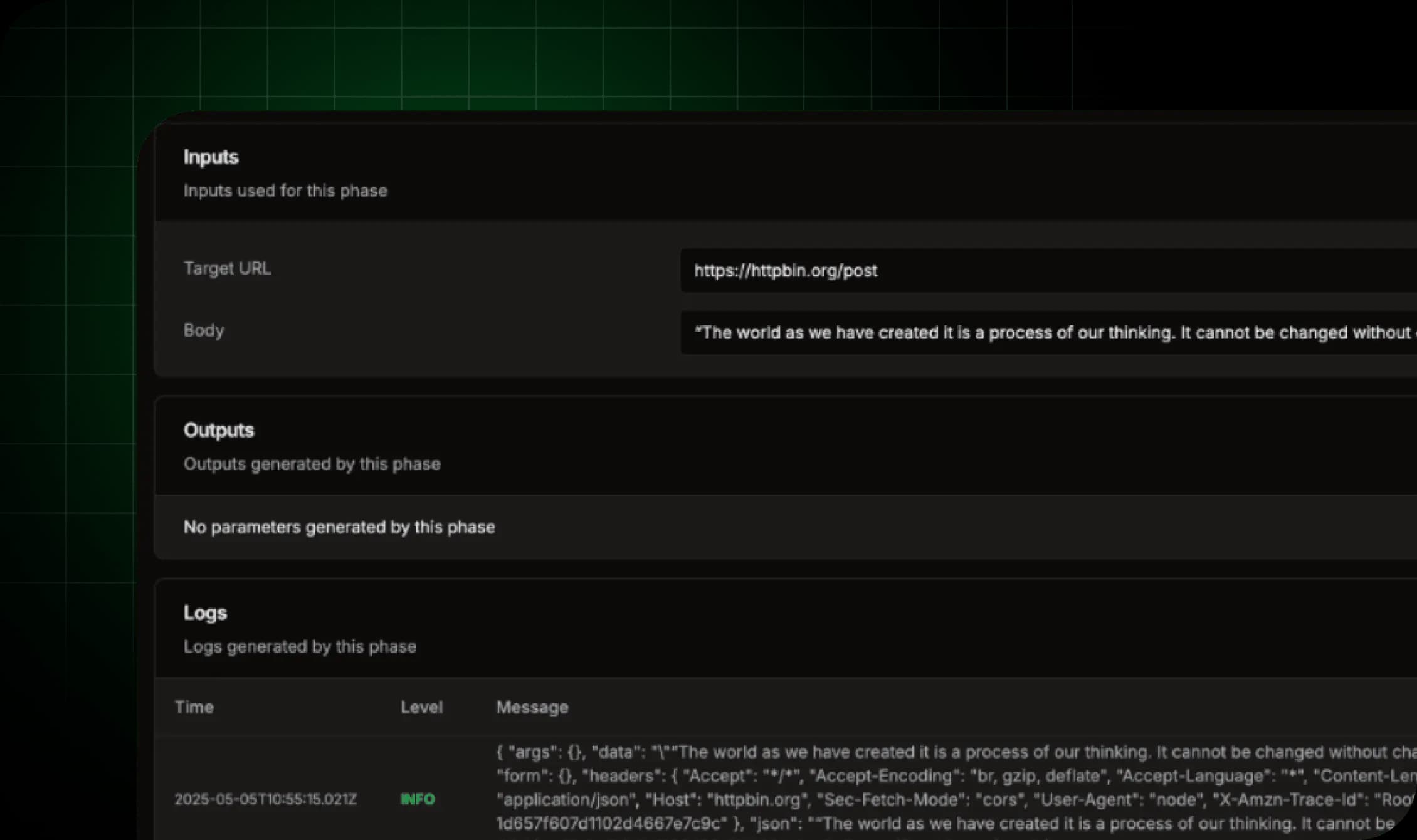
Structured JSON Output
03 — Structured JSON Results
This screenshot proves: Raw HTML converted to clean, strongly typed JSON schemas.
Why it matters: Eliminates regex post-processing and custom cleaning scripts for extracted datasets.
Full Technical Architecture
Built strictly from verified repository components with high-performance modern web technologies:
FRONTEND & DAG
Next.js 14, React 18, React Flow canvas, Tailwind CSS
DATABASE & ORM
PostgreSQL (Neon DB) with Prisma ORM (7 core models)
BROWSER AUTOMATION
Puppeteer headless Chromium with stealth bypass
AI EXTRACTION
Google Gemini & OpenAI API structured JSON output
AUTHENTICATION
Clerk Auth multi-tenant session management
BILLING & CREDITS
Stripe checkout sessions with credit pack consumption
INFRASTRUCTURE
Docker container, Kubernetes manifests, Helm charts
DISPATCH
Webhook delivery with encrypted credential store
BUSINESS VALUE
What the Platform Enables
- Builds Scraping Pipelines Visually: Connects complex multi-step browser tasks in a clean React Flow canvas without coding.
- Resilient to HTML Redesigns: Uses AI schema extraction to parse meaning rather than relying purely on brittle CSS paths.
- Bypasses Client Rendering Overhead: Direct `__NEXT_DATA__` extraction pulls raw JSON in milliseconds where supported.
- Automates Downstream Integration: Automatically dispatches validated datasets directly to external API endpoints.
SCOPE & HONEST BOUNDARIES
Demonstration Boundaries
This portfolio case study demonstrates the visual React Flow workflow builder, headless Puppeteer interaction engine, and AI schema synthesis architecture.
Target domain scraping respects robots.txt and rate-limiting guidelines; proprietary client proxies, commercial CAPTCHA solving tokens, and live user databases are sandboxed.
* Zero fabricated success metrics or unverified client data scale claims are made.
How CrawlMindAI Connects Across the Portfolio
Every project in this portfolio represents a specialized phase of the digital growth lifecycle:
EXTRACT / INGEST
CrawlMindAI
Automates web data collection & competitive intelligence.
ATTRACT / CREATE
SearchFoundry
Programmatic content generation & graph linking.
MONITOR / DETECT
TrafficSentinel
90-day search decay detection & refresh briefs.
MEASURE / ATTRIBUTE
Pathfinder MTA
ClickHouse cookieless tracking & Markov attribution.
What This Project Demonstrates
CrawlMindAI demonstrates full-stack software engineering across visual DAG graph builders, distributed headless browser automation, and AI-powered data normalization. It proves the ability to engineer commercial SaaS platforms that solve difficult data ingestion and automation challenges through resilient architecture.
ENGINEERING INTERVIEW CHEATSHEET // RECRUITER DEFENSE
Recruiter Q&A: Architectural Soundbites
Direct answers to high-stakes interview questions regarding React Flow DAG execution, anti-bot resilience, and AI schema parsing.
Q1: How does CrawlMindAI compile a visual React Flow graph into an executable scraping plan?
Answer: React Flow nodes and edges are validated for topological dependency ordering using a directed acyclic graph (DAG) compilation algorithm. The system verifies that every node has required prerequisite inputs (e.g. an element click node must receive a valid page context from a browser navigation node) and generates an ordered execution plan with discrete phases stored in PostgreSQL.
Q2: How do you handle bot detection and Cloudflare challenges?
Answer: Through stealth browser arguments and WAF evasion techniques. The Puppeteer instance strips automation indicators (like navigator.webdriver = false), randomizes user-agent headers and viewport dimensions, and injects realistic mouse movements and scroll delays. Additionally, where target sites use Next.js, our direct __NEXT_DATA__ extraction bypasses headless browser execution entirely by fetching raw JSON hydration payloads.
Q3: Why use an LLM for data extraction instead of pure CSS selectors?
Answer: Fragility. Pure CSS and XPath selectors break whenever a target website pushes a minor frontend UI redesign, changes class naming conventions, or injects random Tailwind hashed classes. An LLM acts as an adaptive semantic layer: given an HTML block and an extraction prompt, it understands context (like product title, price, or description) regardless of DOM structure, resulting in self-healing scrapers.
Q4: How does usage metering and credit consumption work?
Answer: Each task node in the registry has a predefined credit cost based on computational overhead (e.g. simple navigation costs 1 credit, while AI extraction costs 5 credits). In our Prisma schema, the WorkflowExecution atomic transaction verifies the user's UserBalance before launching workers. If successful, credits are deducted per phase, backed by Stripe credit pack purchases.
Available for 2026 Roles
Let's build repeatable growth engines.
I'm open to Digital Growth, Technical SEO, SaaS, AI Automation, and Analytics opportunities.