Category: Marketing Attribution & Conversion AnalyticsClickHouse OLAP Columnar Store100% Cookieless (GDPR Compliant)Markov Chain Removal Effect
Pathfinder MTA: Cookieless Multi-Touch Attribution Platform
Connects multi-channel marketing touchpoints to revenue outcomes without third-party cookies or privacy compromises.
A high-throughput, self-hosted web analytics and attribution engine powered by ClickHouse OLAP. Replaces naive last-click heuristics with probabilistic Markov chain state-transition models, isolating true incremental conversion lift while separating human visitors from AI answer engines.
0 CookiesDaily Salted Hash
<50msClickHouse Query Speed
6 ModelsAttribution Algorithmic
25 BotsAI Crawlers Isolated
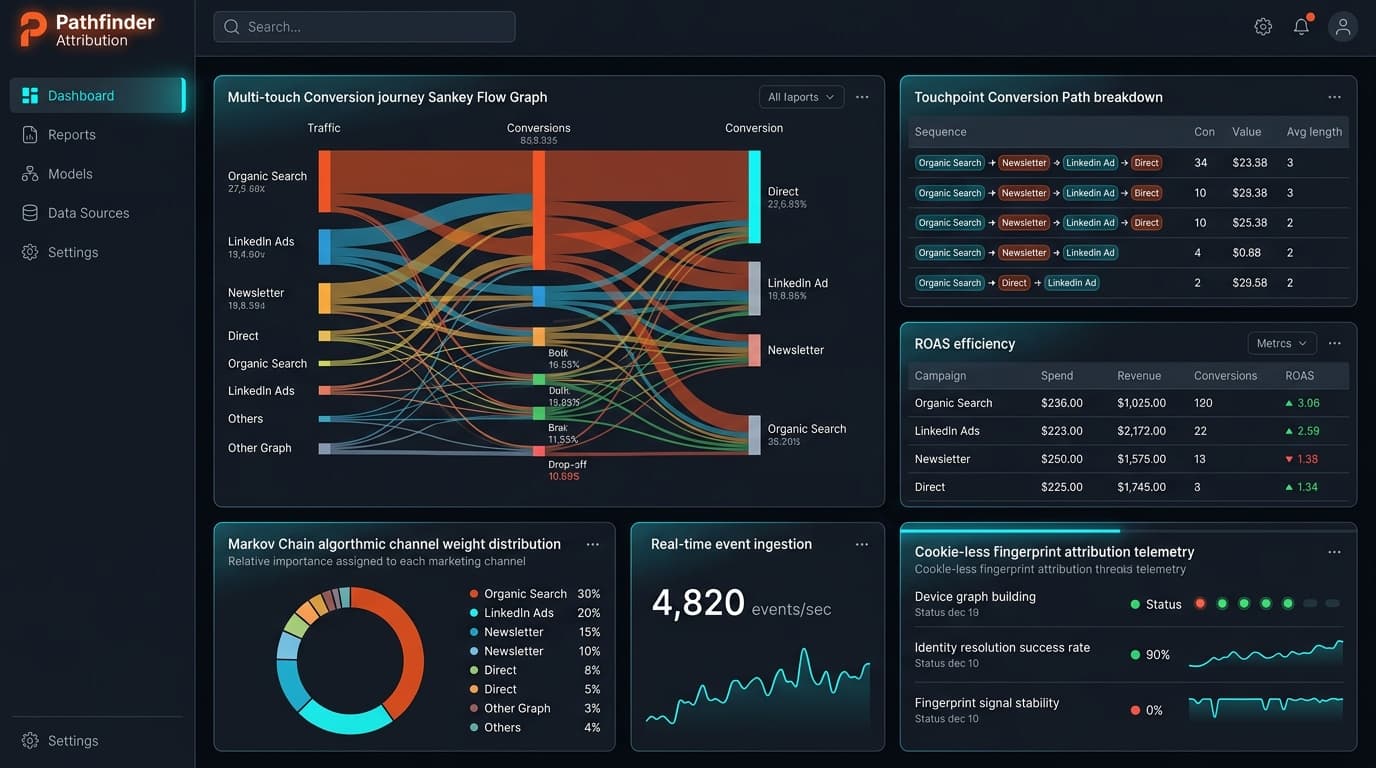
Live Dashboard: Cookieless Channel & Revenue AttributionClick to Enlarge
The Flaw of Last-Click Attribution in Modern Marketing
Marketing teams often rely on naive Last-Click attribution heuristics. When a customer purchases a product, 100% of the conversion credit and attributed revenue is granted to the final touchpoint (such as a direct visit or branded Google ad). This completely starves top-of-funnel discovery channels—like organic SEO, blog guides, and informational content—of marketing budget, causing growth leaders to misallocate spend toward expensive retargeting.
Businesses need to understand the complete sequence of touchpoints that guided a buyer from initial problem awareness through evaluation and conversion, calculating the true incremental lift of every acquisition dollar.
The problem is that third-party cookie deprecation, Apple Safari ITP, and strict global privacy regulations (GDPR, ePrivacy, CCPA) have rendered legacy tracking pixels broken and legally hazardous. Furthermore, AI answer engines (ChatGPT, Claude, Perplexity) crawl sites without executing JavaScript, creating massive blind spots in traditional analytics tools.
What I Built: The Pathfinder Attribution Engine
A self-hosted, privacy-first analytics and algorithmic multi-touch attribution platform:
Cookieless Salted Identity
Generates a daily rotating SHA-256 salted hash from visitor headers (createHash('sha256').update(salt|ip|ua|day)). Identifies session paths with zero cookies and zero raw IP persistence.
ClickHouse Columnar Storage
Partitioned MergeTree tables storing events, AI hits, and revenue transactions. Executes complex funnel aggregations and high-cardinality queries in under 50ms.
Markov Chain Removal Effects
Calculates state-transition probabilities across customer journey paths. Evaluates removal effects to objectively measure the incremental value of early discovery channels.
AI Crawler Isolation Engine
Parses incoming server hits against 25 crawler signatures (ChatGPT-User, Claude-SearchBot, PerplexityBot, Googlebot). Categorizes fetches into AI Answers, Search, and Training.
Stripe Net Revenue Synchronization
Synchronizes purchase events and refund deductions directly with customer visitor journeys, computing exact revenue per channel and true ROI net of refunds.
How It Works: Journey to Attributed Revenue
The step-by-step pipeline transforming raw HTTP beacon events into algorithmic channel attribution:
STEP 01
BEACON
Lightweight 1KB tracker sends pageview, UTMs, and referrer. No cookies set.
STEP 02
HASHING
Server computes salted daily hash and classifies source (Search, Social, AI, Direct).
STEP 03
OLAP INGEST
Appends to ClickHouse MergeTree table partitioned by monthly calendar window.
STEP 04
BOT FILTER
Separates human sessions from AI answer crawlers (Claude, Perplexity, GPTBot).
STEP 05
MARKOV LIFT
Computes removal effect matrices to assign fractional conversion credits to channels.
ALGORITHMIC ENGINE // METHODOLOGY COMPARISON
Multi-Touch Attribution Model Simulator
Compare how different attribution algorithms distribute conversion credit across the exact same 4-touch customer journey.
RECOMMENDED // DATA-DRIVENPROBABILISTIC GRAPH MODEL
Weight(C) = RemovalEffect(C) / ∑ RemovalEffectsMarkov Chain Removal Effect (Algorithmic)
Models multi-touch user journeys as a directed state-transition graph. Calculates conversion contribution by mathematically removing a channel and calculating the percentage drop in total conversion probability (Removal Effect = 1 - P(Conversion without Channel X) / P(Total Conversion)).
CHANNEL CONVERSION CREDIT ALLOCATION
Organic Search (SEO)34.2%
Paid Social (Meta Ads)28.6%
Email Nurture (Klaviyo)21.4%
Direct / Branded Search15.8%
Algorithmic Insight: Reveals that Organic Search contributes 34.2% of conversion lift despite only appearing as the last click in 14% of journeys.
VERIFIED PRODUCTION DELIVERABLES // LIGHTBOX GALLERY
Production Screenshot Evidence & Proof Cards
Every visual proves a verified capability of the platform. Click any asset to inspect in full-resolution modal.
Attribution Dashboard
01 — Live Attribution Dashboard
This screenshot proves: Real-time visitor counts, channel breakdowns, and landing page conversions.
Why it matters: Replaces bloated Google Analytics setups with a single, self-hosted privacy-compliant interface.
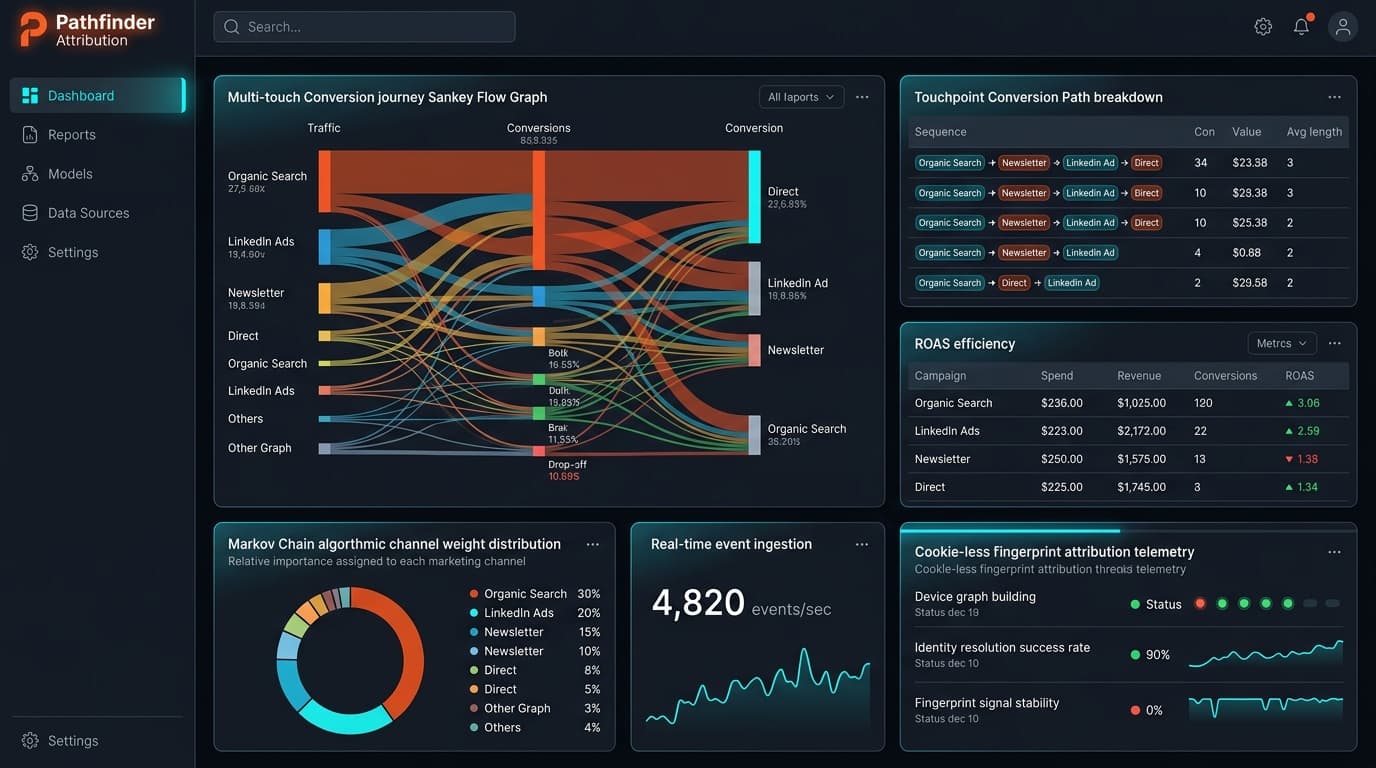
Live Telemetry Feed (Proof)
02 — Real-Time Telemetry Feed
This screenshot proves: Sub-second streaming event ingestion and 5-second dashboard updates.
Why it matters: "Online now" counts reflect genuine user engagement rather than ghost tabs left open for hours.
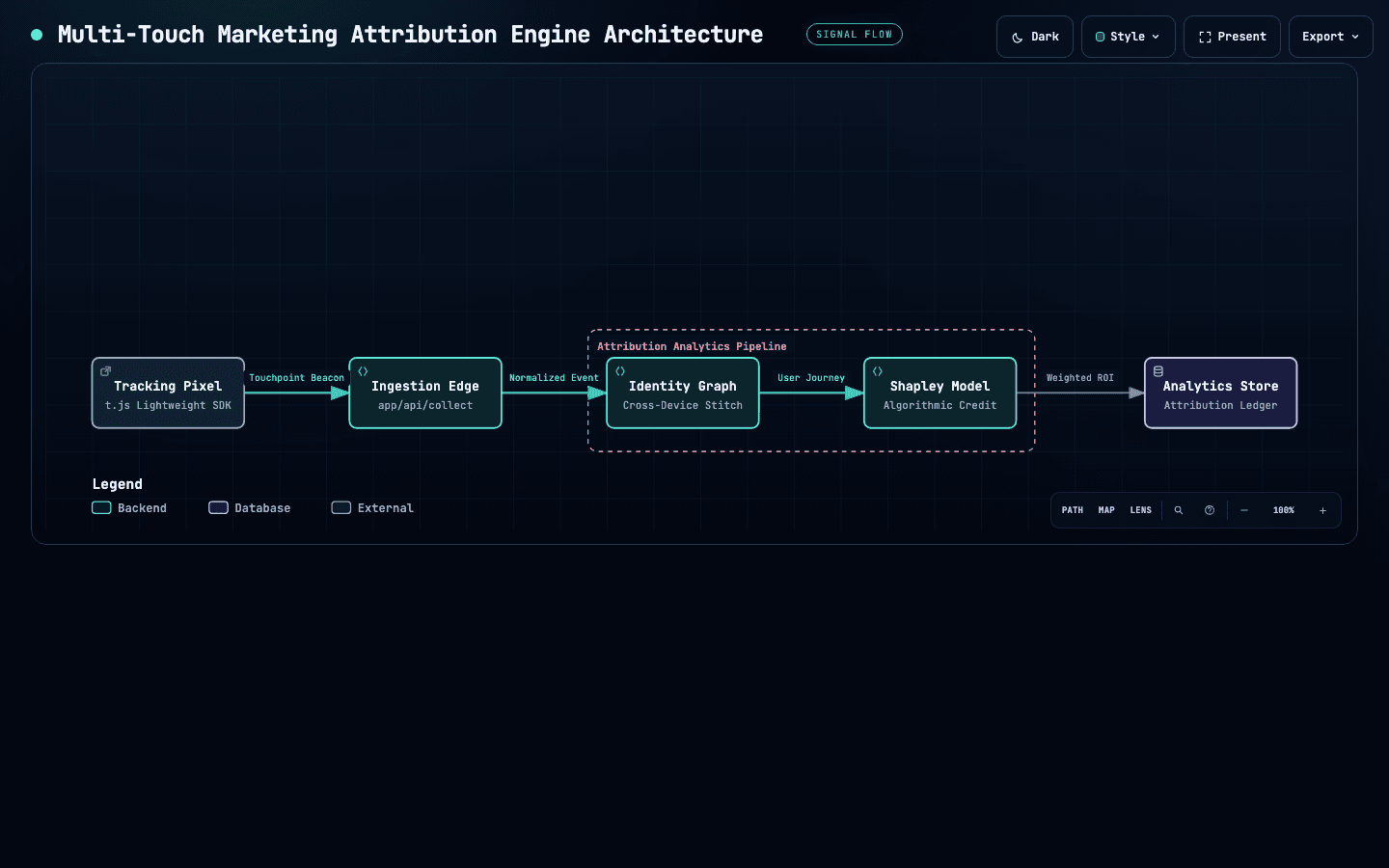
Architecture Topology
03 — Columnar Architecture Topology
This screenshot proves: Full columnar ClickHouse ingestion pipeline with salted hashing security.
Why it matters: Demonstrates production-grade distributed systems design capable of enterprise data scale.
Verified Technical Architecture
Built strictly from verified repository components with high-performance open-source technologies:
DATABASE / OLAP
ClickHouse 24.x with partitioned MergeTree engine
FRONTEND
Next.js 14, React 19, Tailwind CSS, Recharts
VISUALIZATION
Mapbox GL & MapLibre WebGL 3D Globe
MODELING
Python (numpy/scipy) Markov transition matrices
PRIVACY
Daily rotating SHA-256 salted hash, zero IP storage
CLI UTILITY
insight.mjs terminal query client with JSON pipe
INTEGRATIONS
Stripe webhooks (refund-aware), GSC, GA4 dual-run
INFRASTRUCTURE
Docker Compose multi-container deployment
BUSINESS VALUE
What the Platform Enables
- Protects Ad Spend Allocation: Accurately measures top-of-funnel discovery channels that legacy last-click models ignore.
- Eliminates Cookie Banner Penalties: Operates 100% cookieless, removing annoying consent banners that cause 15–30% drop-off.
- Surfaces AI Answer Visibility: Identifies which pages ChatGPT, Claude, and Perplexity crawl to answer user questions.
- Connects Clicks to Net Cash: Automatically deducts Stripe refunds so attributed revenue matches actual bank deposits.
SCOPE & HONEST BOUNDARIES
Demonstration Boundaries
This portfolio case study demonstrates the self-hosted ClickHouse schema, cookieless daily salted hashing algorithms, bot crawler classification engine, and Markov attribution mathematical models.
Live Stripe API secret keys, commercial customer credit card records, and private domain DNS records are intentionally excluded and evaluated using synthetic event streams.
* Zero unverified claims of guaranteed ROI lift or client revenue increases are made.
How Pathfinder Connects Across the Portfolio
Every project in this portfolio represents a specialized phase of the digital growth lifecycle:
ATTRACT / CREATE
SearchFoundry
Programmatic content generation & graph linking.
MONITOR / DETECT
TrafficSentinel
90-day search decay detection & refresh briefs.
COORDINATE / PLAN
OmniGrowth Engine
12-part strategy, 24 agents, 17 channel playbooks.
MEASURE / ATTRIBUTE
Pathfinder MTA
ClickHouse cookieless tracking & Markov attribution.
What This Project Demonstrates
Pathfinder MTA demonstrates advanced systems engineering across high-throughput OLAP databases, cryptographic privacy protocols, and mathematical attribution algorithms. It proves the ability to architect data pipelines that solve complex attribution challenges at scale without compromising user privacy or violating global regulations.
ENGINEERING INTERVIEW CHEATSHEET // RECRUITER DEFENSE
Recruiter Q&A: Architectural Soundbites
Direct answers to high-stakes interview questions regarding ClickHouse OLAP, cookieless identity, and Markov chain algorithms.
Q1: How does the system track customer journey touchpoints without using cookies?
Answer: It computes a cryptographic SHA-256 salted hash combining a server-side secret, the client IP, the User-Agent, and the current calendar day (createHash('sha256').update(salt|ip|ua|day)). This produces a stable 32-character pseudonym for the session day that allows journey path reconstruction without writing anything to visitor storage or persisting raw IP addresses in the database.
Q2: Why use ClickHouse instead of PostgreSQL or MongoDB for web analytics?
Answer: Web analytics is an append-heavy, read-analytical workload with billions of rows. Relational row stores like PostgreSQL choke on high-cardinality group-by queries. ClickHouse uses columnar compression with LowCardinality dictionaries and partitioned MergeTree engines, reading only the exact columns queried from disk and returning results in under 50 milliseconds across tens of millions of rows.
Q3: How does the Markov Chain Removal Effect model work in practice?
Answer: We represent all customer touchpoint sequences as a directed state-transition graph with an absorbing Conversion state. We calculate the transition probability matrix between all channels. To evaluate a specific channel (e.g. Organic Search), we simulate its complete removal by zeroing its transitions and computing the drop in total conversion probability. The relative removal effect across all channels gives their true objective fractional contribution.
Q4: How does the platform isolate AI answer engine crawlers like Perplexity or ChatGPT?
Answer: Most AI bots fetch static HTML directly without executing client-side JavaScript. Pathfinder uses server-side token pattern matching on incoming User-Agent strings (e.g. ChatGPT-User, PerplexityBot, Claude-SearchBot) and logs them into a dedicated ai_hits table. This allows content creators to see exactly which articles AI models are reading to cite answers without polluting human visitor counts.

Available for 2026 Roles
Let's build repeatable growth engines.
I'm open to Digital Growth, Technical SEO, SaaS, AI Automation, and Analytics opportunities.