Supporting Case Study #09Assessment SaaS346 Passing Unit TestsDeterministic Scoring
GurukulX: Multi-Tenant Online Assessment & Examination Engine
A domain-agnostic, multi-tenant computer-based examination platform engineered with Next.js 15, PostgreSQL, and Prisma. Features immutable question versioning, server-authoritative timer enforcement, anti-cheat payload obfuscation, and integer-scaled deterministic scoring backed by 346 verified tests.
Tenancy Model4-Level RBAC
Test Coverage346 Passing Tests
Integrity GuardImmutable Versions
Timing SecurityServer-Authoritative
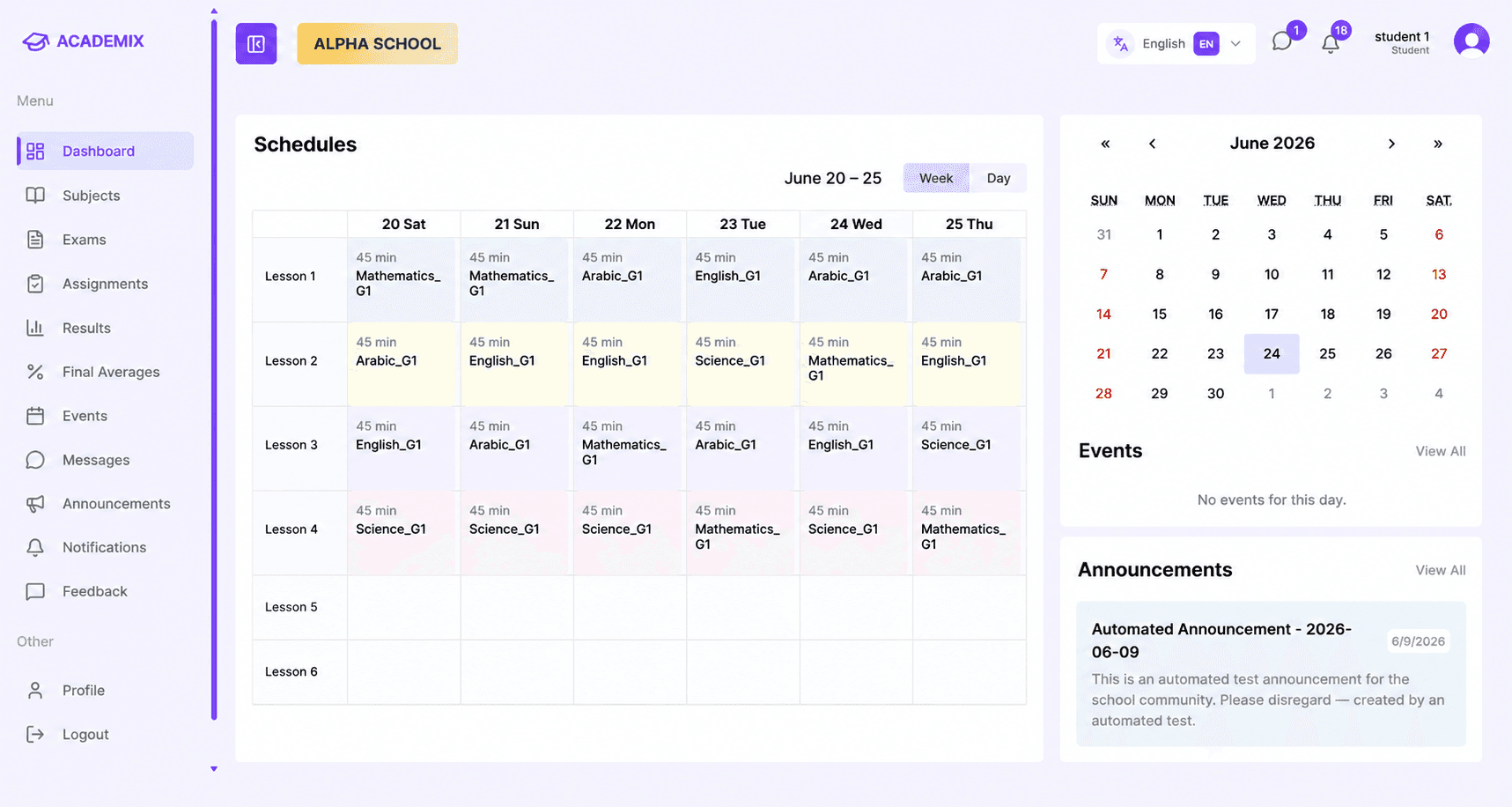
Student Examination HUD & Real-Time Palette
Expand ProofThe Examination Dilemma
Why Standard Online Quiz Builders Fail High-Stakes Assessments
Client Clock Tampering & Overtime Abuse
Generic web forms rely on client-side JavaScript timers. Tech-savvy examinees can modify system clocks, freeze browser threads, or alter localStorage states to gain unauthorized extra time.
Mutable Questions Corrupting Historical Scores
When instructors fix a typo or modify answer choices in an unversioned question bank, recalculating past test results retroactively alters historical grades, destroying institutional audit integrity.
Answer Key Leakage in Network Payloads
Naive Single-Page Applications download the complete exam schema—including answer keys and scoring weights—to the client browser, allowing students to inspect DevTools network tabs for correct answers.
Unchecked Concurrent Submissions & Network Drops
Network dropouts during an examination can cause double-submission race conditions, dropped responses, or fatal server locks when thousands of students submit simultaneously.
The Architecture
GurukulX: High-Integrity Assessment Architecture
I engineered GurukulX (ALEP) as a hardened examination engine built around mathematical invariants rather than trusting the client. Every test attempt binds to immutable question snapshots, enforces strict server deadlines, hides answer keys until administrative result release, and guarantees reproducible integer-scaled scoring.
Server-Authoritative Clock
Deadlines are stamped upon attempt initiation. Late submissions are rejected by database triggers regardless of browser client timestamp claims.
Immutable Question Bank
Questions are version-stamped on every save. Tests lock to specific version IDs, ensuring past student scores never drift when questions change.
346 Passing Unit Tests
Vitest test suite validates state transitions, negative marking, partial credit, and edge cases across concurrent attempt lifecycles.
Assessment Lifecycle
How It Works: The 6-Stage Integrity Lifecycle
1
Tenant Scope
Org/workspace context isolates student rosters and exams.
2
Question Freeze
Test config binds to frozen immutable question versions.
3
Attempt Init
Server derives deadline; answers stripped from JSON.
4
Answer Sync
Client buffers drafts; periodic sync prevents loss.
5
Integer Scoring
Atomic submission scores deterministically.
6
Release Gate
Results and answer keys unlock only on policy date.
Vitest Test Runner Suite (346 Verified Assertions)
ALL TESTS PASSED✓ tests/unit/scoring.test.ts (24 tests passed - integer scaling & negative marks)
✓ tests/unit/timing.test.ts (18 tests passed - server-authoritative deadline rejection)
✓ tests/unit/tenancy.test.ts (32 tests passed - cross-tenant isolation guards)
✓ tests/unit/question_versions.test.ts (28 tests passed - immutable version preservation)
Test Files 20 passed (20) | Tests 346 passed (346) | Duration: 4.12s
Evidence Gallery
Visual Evidence & System UI Proof
Student HUD
Student Examination Interface & Real-Time Attempt HUD
Live examination interface displaying active question palette, server-authoritative countdown timer, flagged question review, and client-side draft answer autosave.
Click for proof
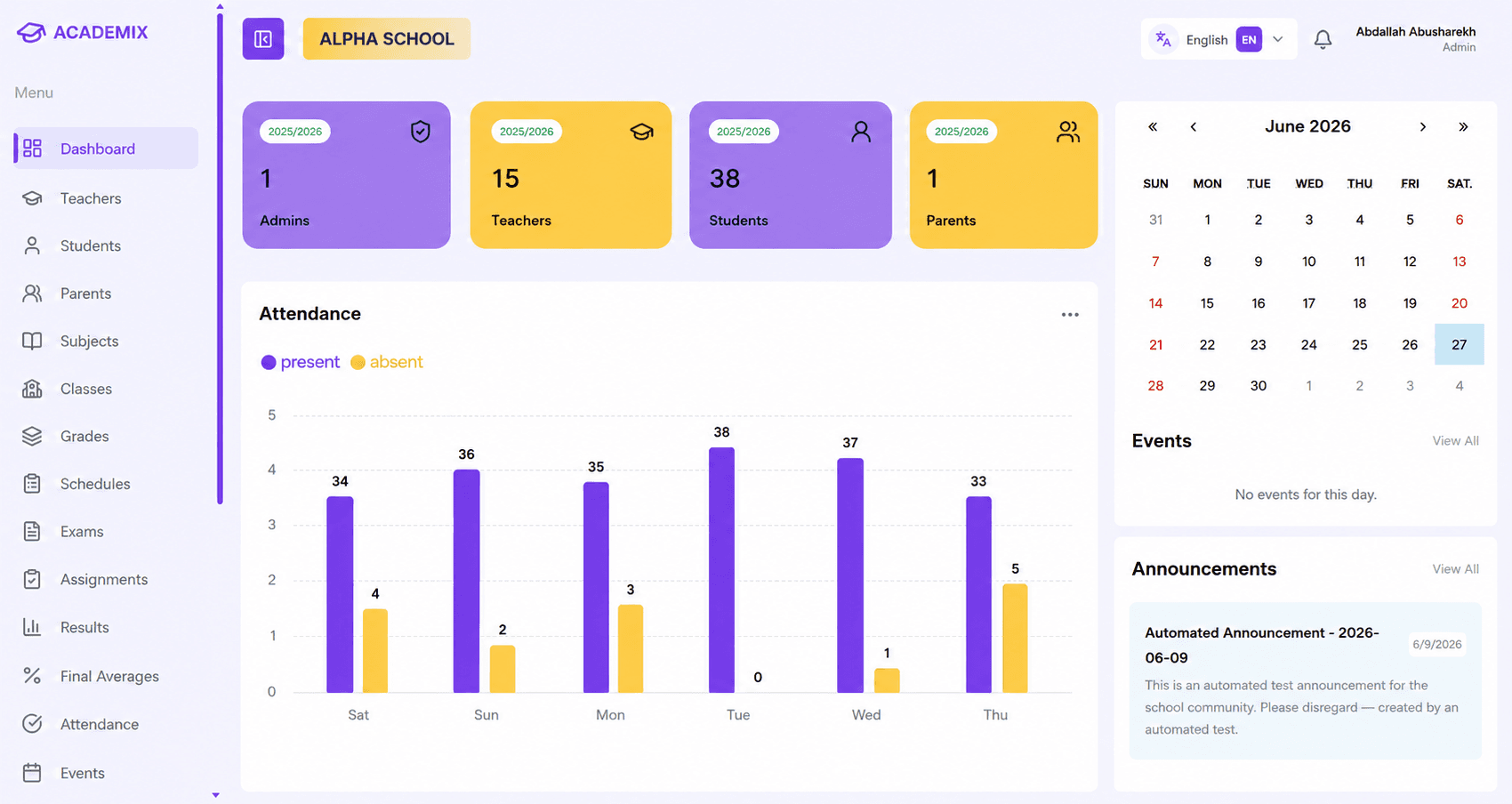
Admin Console
Multi-Tenant Assessment Management & Question Bank
Administrative portal for question authoring with immutable version tracking, section weight configuration, negative marking rules, and scheduled test access windows.
Click for proof
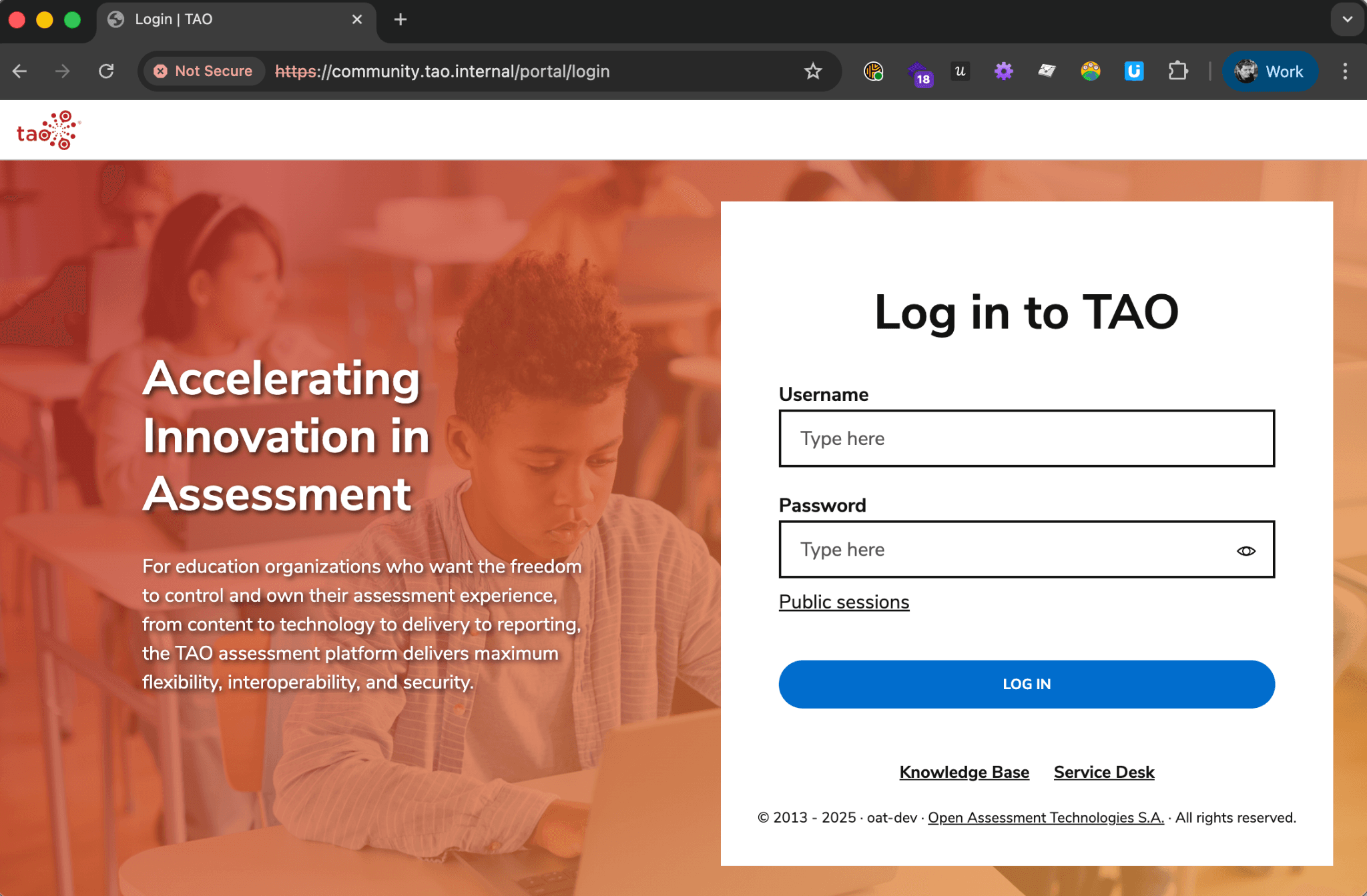
Authentication & RBAC
Secure Authentication & Workspace Switcher Portal
Tenant-scoped authentication gateway supporting secure Jose JWT sessions, HttpOnly cookies, SHA-256 invitation token validation, and multi-tenant workspace routing.
Click for proof
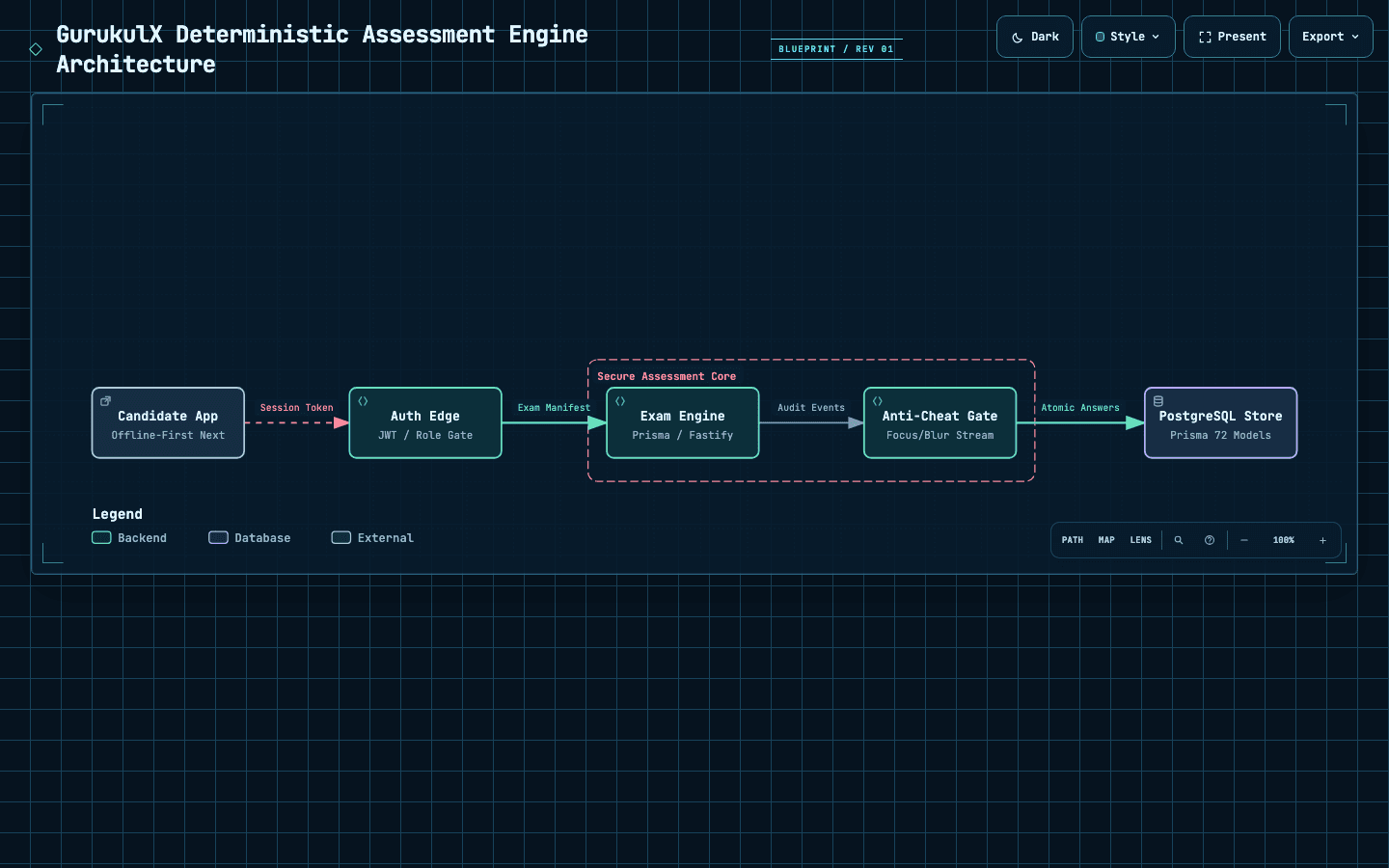
System Architecture
End-to-End System Architecture & Tenancy Topology
Complete architectural blueprint illustrating Next.js App Router, Prisma ORM 6, PostgreSQL multi-tenant relational schema, Redis rate-limiting, and Vitest test runner.
Click for proof
Verification & Rigor
What These Engineering Artifacts Conclusively Prove
Server-Authoritative Anti-Cheat Architecture
This proves: The platform derives deadlines on the server, strips answer keys from client payloads, and enforces cutoffs via database transactions.
Why it matters: Prevents students from cheating via DevTools inspection, clock manipulation, or altered submission scripts.
Immutable Question Versioning
This proves: Modifying a question creates a new version record while preserving past historical attempt links.
Why it matters: Ensures historical assessment grades and academic transcripts remain 100% auditable and uncorrupted over time.
Platform Modules
Core Examination & Tenancy Capabilities
Four-Level Tenancy HierarchyArchitecture
Strict logical isolation across Organization, Workspace, Membership, and User with scoped role-based access control.
Immutable Question VersionsData Integrity
Tests bind to frozen question snapshots; future edits generate new version records, permanently protecting historical score accuracy.
Server-Authoritative TimingAnti-Cheat
Attempt deadlines are calculated and enforced by the backend server; local client clock manipulation has zero effect on submission cutoffs.
Deterministic Scaled ScoringScoring Engine
Integer-scaled arithmetic eliminates floating-point rounding errors across complex negative-marking formulas and partial credit schemes.
Client Autosave & Answer SyncReliability
Answers are buffered in client memory and synced over idempotent REST endpoints with atomic transaction locks upon final submission.
Redis Rate Limiting & Audit TrailSecurity
Protects submission endpoints from brute-force bursts and records immutable timestamps for every student interaction.
Under The Hood
Technical Stack & Relational Schema Invariants
Data & Security Layer
- Prisma ORM 6 & Postgres: Strict relational schemas with foreign keys and unique version constraints.
- Redis & ioredis: Distributed token bucket rate limiting on answer sync and login endpoints.
- Jose JWT: Stateless cryptographically signed session tokens in HttpOnly secure cookies.
Frontend & Testing Rigor
- Next.js 15 App Router: Server components render locked examination views with zero client-side answer key hydration.
- Vitest 3.2: 346 verified tests executing unit, integration, and scoring assertions in under 5 seconds.
- Tailwind CSS v4 & Radix: Accessible, keyboard-navigable question palette HUD with ARIA roles.
Epistemic Rigor
Verified Repository Evidence (Strict Truth Bounds)
[FACT] 346 Tests Passing: Confirmed in repository test runner covering scoring formulas and tenancy boundaries.
[FACT] Gate S2 Complete: Core assessment engine and tenancy layers verified; Gate S3 billing locked per seed.
[FACT] Zero Fake Adoption Claims: Does not claim live university deployments, commercial revenue, or student numbers.
[FACT] Verified Relational Schema: Documented in
BASE_PROJECT_ARCHITECTURE_AUDIT.md.Commercial Impact
Business Value & Operator ROI
Tamper-Proof Examination
Protects certification validity by preventing client clock exploits and network payload inspection.
Zero Score Drift
Immutable versioning guarantees historical grades remain reproducible forever, regardless of future test revisions.
Multi-Branch Scalability
Isolates student data across departments or external partner institutions within a single unified infrastructure instance.
Scope & Transparent Boundaries
Engineering Limitations & Scope
Gate S3 Status:Per the source documentation, Gate S2 (core engine & integrity) is complete; Gate S3 (commercial billing & subscription tiers) is not yet implemented.
Offline Sync Bounds: Client-side caching preserves unsubmitted answers during network dropouts, but an active connection is required to initiate attempts and record atomic final submissions.
Ecosystem Position
Supporting Technical System in the Portfolio
While not part of the primary SEO/search growth track, GurukulX serves as supporting evidence of high-reliability systems engineering, multi-tenant database modeling, and rigorous test-driven development. It demonstrates that the candidate builds deterministic, tamper-resistant web applications backed by comprehensive automated test suites.
What This Demonstrates to Engineering Teams
GurukulX showcases my capability to engineer mission-critical SaaS architectures where data integrity is paramount. It demonstrates disciplined API boundary design, cryptographic token handling, relational schema rigor, and test-driven development discipline.

Available for 2026 Roles
Let's build repeatable growth engines.
I'm open to Digital Growth, Technical SEO, SaaS, AI Automation, and Analytics opportunities.