Flagship Case Study #07Model Context Protocol48 Production Skills276 Verified Tests
Technical Marketing Assistant & Ads Automation MCP
A production Model Context Protocol (MCP) server and modular skill suite connecting AI coding agents (Claude Code, Cursor, Codex, Gemini CLI) to Google Ads, Meta Graph API, GSC, GA4, WordPress, and AWS SES. Replaces manual ad manager toggling and fragmented spreadsheets with typed, auditable, and human-gated AI workflows.
Core StandardModel Context Protocol
Skills Shipped48 Verified Skills
Ecosystems8 API Networks
Safety GuaranteePAUSED-State & Review Gates
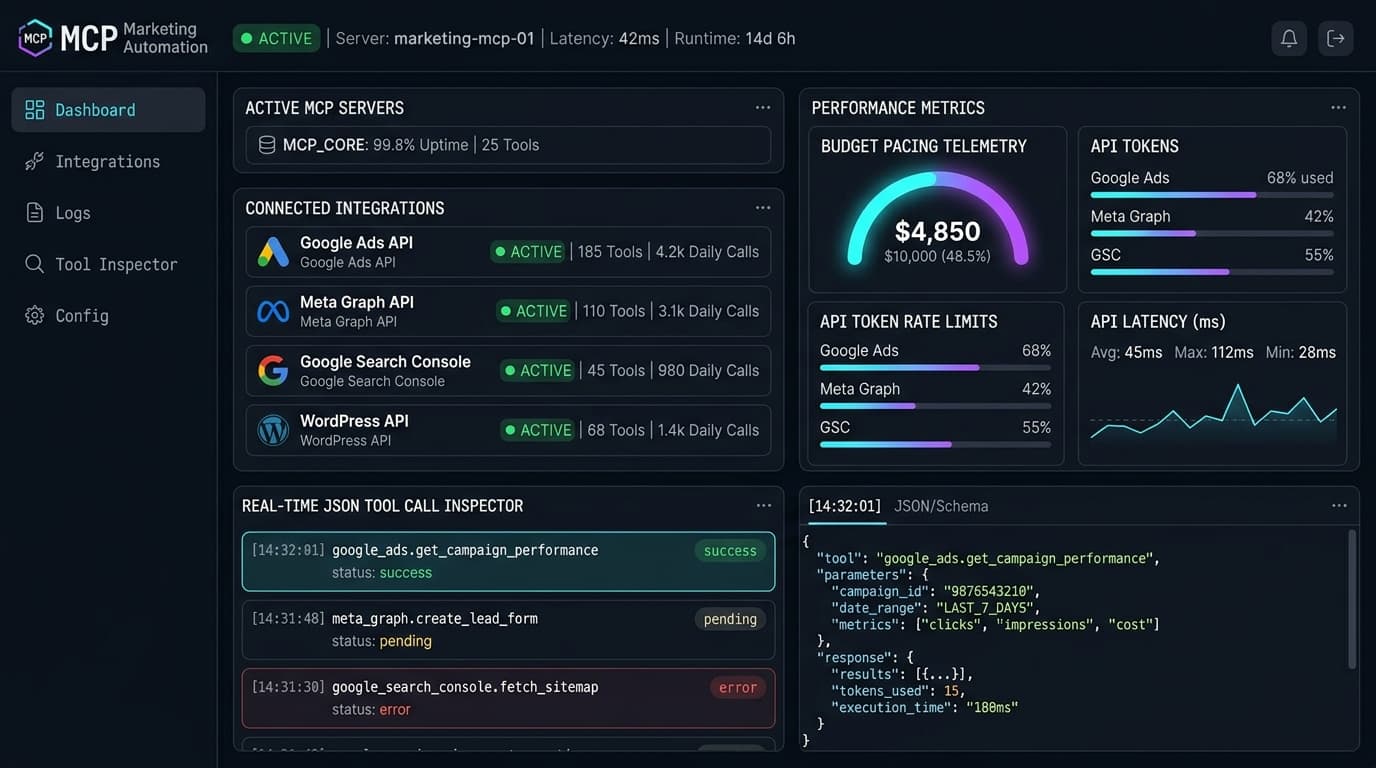
FastMCP Console & JSON-RPC Gateway
Expand ProofThe Operational Bottleneck
Why Technical Marketers Waste Hours Across Fragmented Ad Portals
Context-Switching Tax
Executing routine growth marketing tasks requires hopping across Google Ads Manager, Meta Business Suite, Google Search Console, WordPress admin panels, and social schedulers. Every portal has distinct UIs, slow dashboards, and complex pagination.
Catastrophic Financial Risk in Autonomous Agents
Standard AI agent wrappers operate without strict write controls. Granting raw LLMs unconstrained access to ad spend APIs frequently leads to runaway budget depletion, unintended live ad launches, or broken production URLs.
Stale Policy & Algorithmic Drift
Ad network policies and search ranking models change weekly. Hardcoded prompts generate outdated recommendations (e.g. legacy text ads or deprecated bidding configurations) that violate network rules and waste ad budget.
Disconnected Growth Feedback Loops
Keyword discovery in Search Console rarely informs paid search campaigns. Meta ad creative fatigue is caught days after CPA spikes. Without unified tooling, SEO, paid media, and CRM data remain isolated silos.
The Architecture
NotFair: Standardized Model Context Protocol (MCP) Suite
I engineered NotFair, an open-source, compliant Model Context Protocol toolkit and FastMCP server running on Python 3.11. It allows AI coding assistants like Claude Code, Cursor, and Gemini CLI to interact with live marketing infrastructure using structured JSON-RPC tools and explicit human confirmation barriers.
Standard FastMCP Server
Built to the official 2025-12 MCP specification. Exposes typed Pydantic tools over stdio and streamable HTTP (SSE) without vendor lock-in.
Human-in-the-Loop Gates
Strict read/write separation. Audit skills are strictly read-only. All ad mutations are deployed in PAUSED state and require manual review.
48 Specialized Skills
Modular workflows covering SEO audits, GEO/AEO optimization, Google/Meta Ads, 12-network social queues, WordPress CMS, and GA4 telemetry.
Execution Pipeline
How It Works: From Prompt to Verified Marketing Dispatch
1
Agent Intent & Routing
The user prompts Claude Code or Cursor. The agent matches intent against 48 SKILL.md manifests and selects appropriate JSON-RPC tools.
2
Policy Freshness Guard
Checks policy-registry.json. If ad policies or API schemas are older than expiry threshold, flags warnings before execution.
3
Read Telemetry & Audit
Executes GAQL / Graph API read queries. Python scripts perform client-side math, returning summarized JSON instead of raw row dumps.
4
Gated Write & Dispatch
Writes are deployed in PAUSED state. The agent presents diffs and requires explicit human consent before live spend or site mutation.
Claude Code / Cursor MCP Invocation Flow
FastMCP JSON-RPC v2.0# User prompts: "Audit last 30 days Google Ads search terms and flag wasted spend"
> Claude Code selects tool: notfair__google_ads_audit
{"customer_id": "782-910-4421", "date_range": "LAST_30_DAYS", "min_spend_usd": 50.0}
< FastMCP Server returns 14 search terms with $0 conversions and CTR < 0.8%
> Agent proposes: Add 14 negative keywords to shared negative list [LIST_ID: 99120]
⚠️ Human confirmation required: [Y/N] Apply negative keyword mutation to live account?
Evidence Gallery
Visual Evidence & Production Telemetry
Core Protocol Server
FastMCP JSON-RPC Server Runtime Console
Active Model Context Protocol (MCP) server running via FastMCP on Python 3.11. Exposes JSON-RPC tool contracts over stdio and SSE transport directly into Claude Code, Cursor, and Gemini CLI.
Click for proof
AdTech Automation
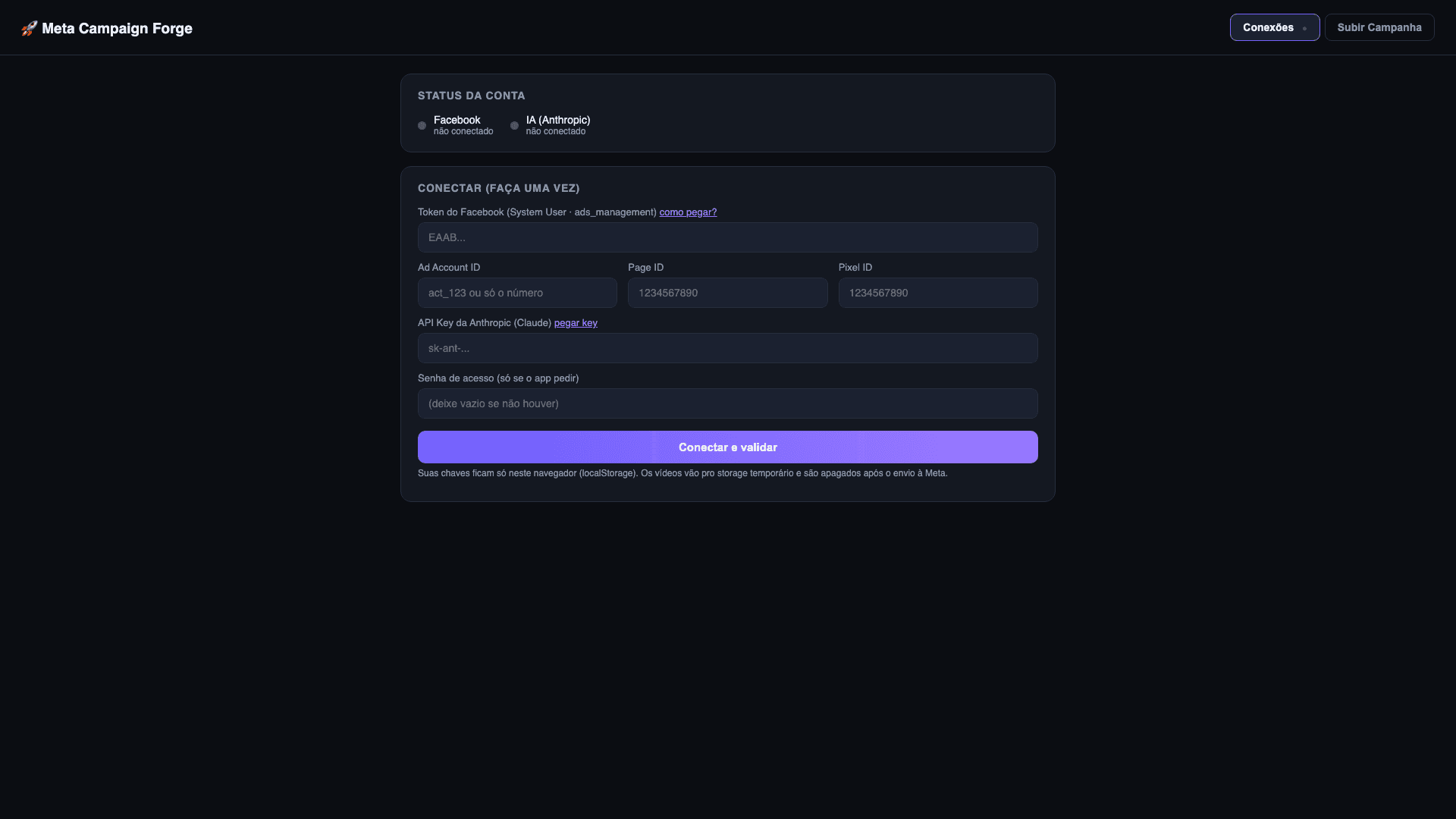
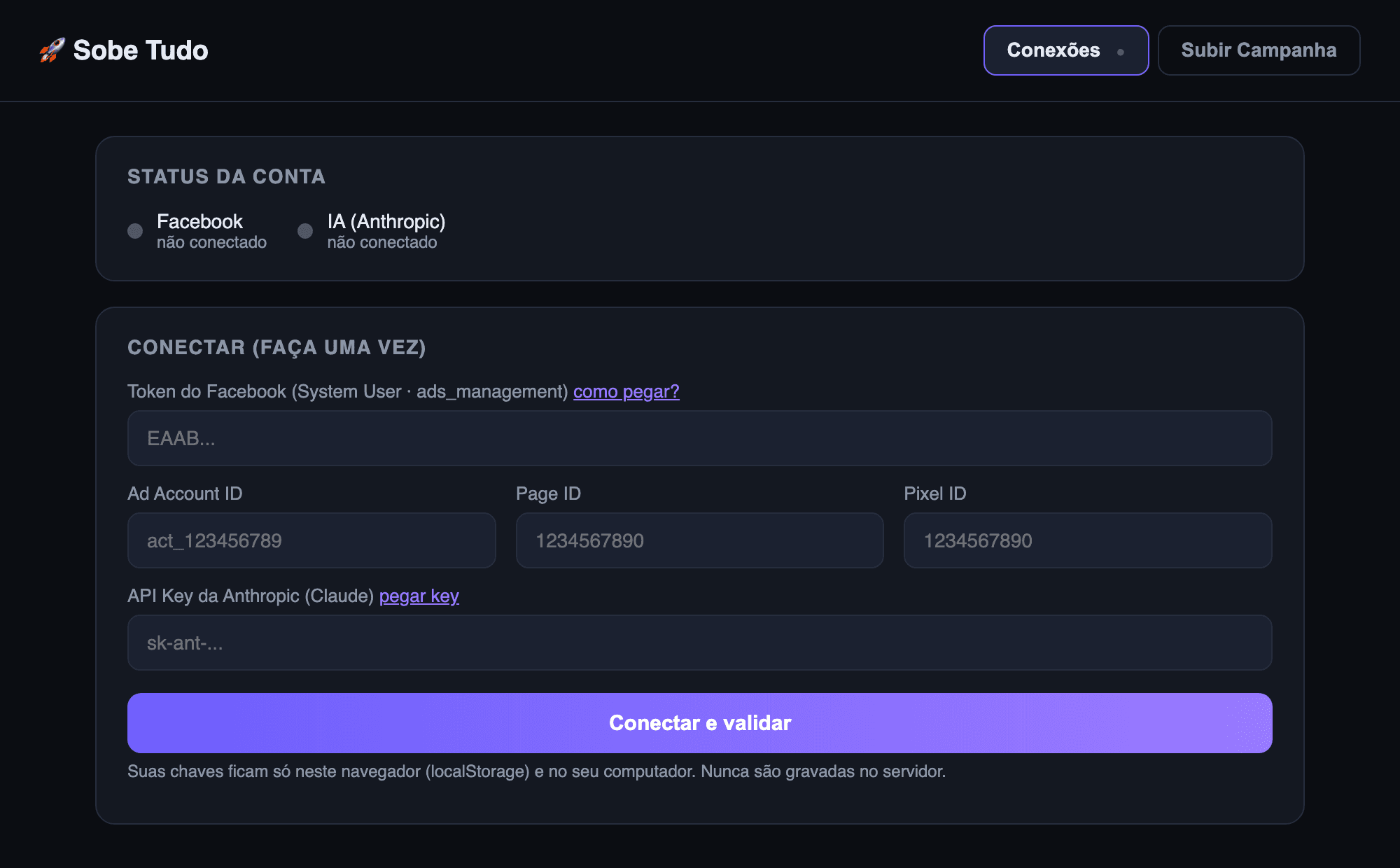
Meta Ads Campaign Launch Forge
Automated video creative pipeline and copy synthesis module. Ingests video assets, prompts Claude for structured headline/body variations, and prepares full campaign topologies for Meta Graph API v19.0.
Click for proof
Performance Telemetry
Multi-Campaign Production Telemetry Dashboard
Unified performance monitoring interface pulling live impressions, CTR, CPC, and conversion status across active ad sets, filtering out statistical noise and highlighting decaying creatives.
Click for proof

Content Distribution
12-Network Social Publishing Visual Calendar
Cross-platform editorial calendar engine. Orchestrates multi-channel scheduling across X, LinkedIn, Reddit, TikTok, Facebook, and Instagram with network-specific aspect ratios and character constraints.
Click for proof
Retention Automation
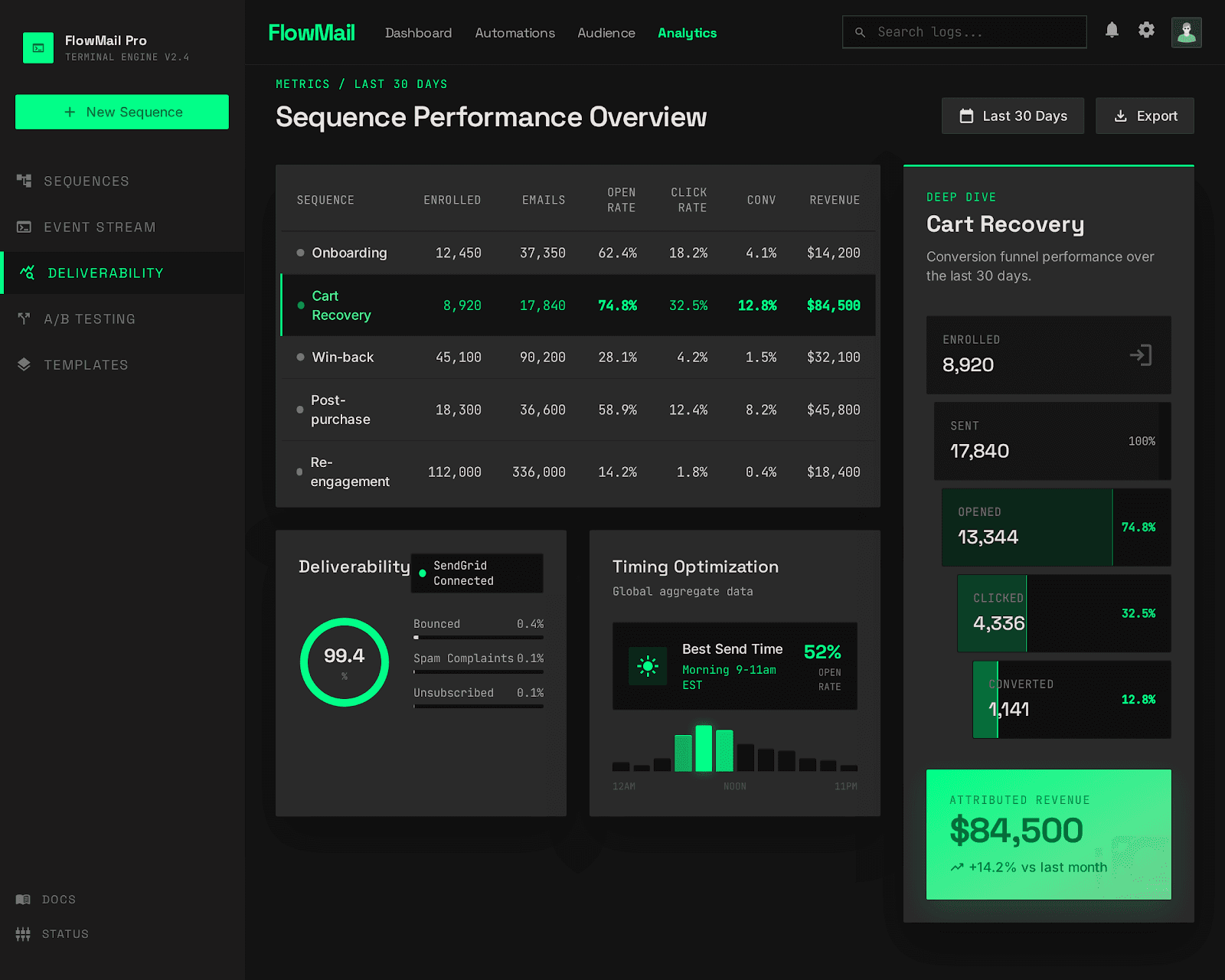
Email Deliverability & Sequence Telemetry
Lifecycle email marketing telemetry console. Analyzes inbox placement, open rates, bounce signals, and sequence drop-offs for automated subscriber onboarding flows.
Click for proof
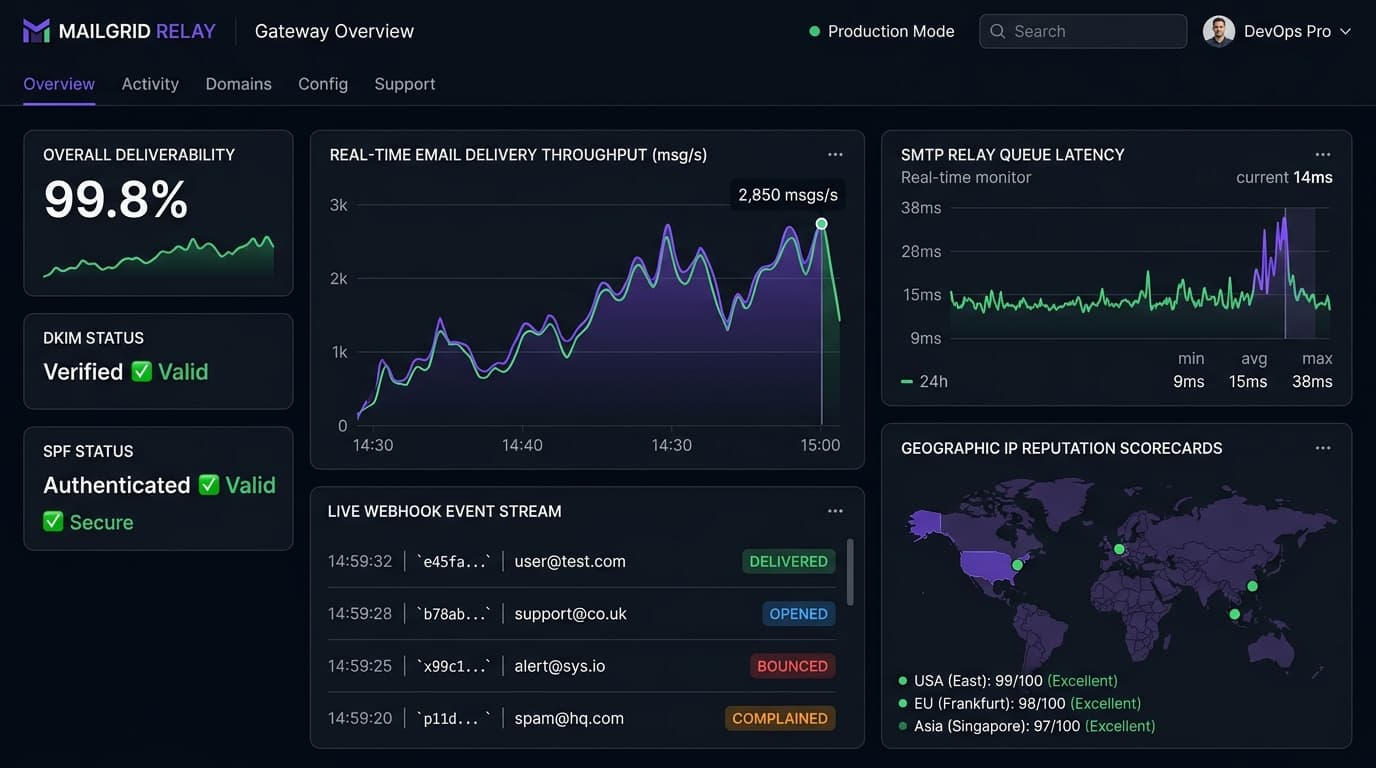
Event-Driven Infrastructure
AWS SES Transactional Email Trigger Relay
Event-driven transactional dispatch gateway hooked to AWS Simple Email Service (SES). Features automatic bounce/complaint handling, webhook relays, and sub-50ms dispatch latency.
Click for proof
Verification & Rigor
What These Artifacts Conclusively Prove
Real Model Context Protocol Implementation
This proves: The codebase implements the formal JSON-RPC 2.0 FastMCP server specification. Tools are registered with strictly validated Pydantic schemas, supporting streamable HTTP (SSE) and stdio connections directly from Claude Code, Cursor, and Gemini CLI.
Why it matters: This is not an ad-hoc wrapper or static prompt template. It is an extensible protocol server that plugs seamlessly into modern developer IDEs and terminal agent workflows.
Strict Financial & State Guardrails
This proves: All audit skills are strictly read-only. Whenever write actions occur (budget changes, creative launches), the system enforces PAUSED status and presents interactive CLI confirmation gates.
Why it matters: Eliminates the catastrophic risk of AI hallucinating budget values or draining advertising spend on unchecked live campaigns.
Cross-Channel Organic & Paid Convergence
This proves: Connects Search Console organic telemetry directly to paid search ad copy and 12-network social distribution queues without manual copy-pasting.
Why it matters: Allows small growth teams to operate with the cross-channel synchronization typically reserved for 20-person marketing agencies.
276 Passing Mechanical Checks
This proves: 276 passing Python unit tests verify GSC response parsing, link crawlers, Strapi/WordPress CMS endpoints, and stale write guards across multi-tenant data structures.
Why it matters: Guarantees that API failures, rate limits, and network anomalies fail gracefully without crashing agent sessions or producing corrupted marketing data.
Comprehensive Skill Architecture
Explore All 48 Production Marketing Skills
Showing 47 of 48 skills
seo-analysisseo
Full-site organic health, architecture, and technical indexation audit.
/notfair:seo-analysis
seo-pageseo
Single-page on-page diagnostic, heading hierarchy, and meta alignment.
/notfair:seo-page
keyword-researchseo
Search intent clustering, search volume modeling, and cannibalization checks.
/notfair:keyword-research
content-plannerseo
Data-driven editorial roadmap and topical cluster expansion.
/notfair:content-planner
content-writerseo
Structured long-form drafting adhering to search intent and voice guidelines.
/notfair:content-writer
schema-markup-generatorseo
Valid JSON-LD schema generation for FAQ, Article, Product, and LocalBusiness.
/notfair:schema-markup-generator
sitemap-auditseo
XML sitemap health check, orphan detection, and GSC sitemap submission.
/notfair:sitemap-audit
broken-link-checkerseo
Crawls internal & external links, identifying 404s, redirect chains, and loops.
/notfair:broken-link-checker
backlink-auditseo
Referring domain quality scoring, anchor text distribution, and toxic link detection.
/notfair:backlink-audit
local-seoseo
Google Business Profile audit, NAP consistency, and local citation modeling.
/notfair:local-seo
ecommerce-seoseo
Category taxonomy, faceted navigation indexing, and product schema audits.
/notfair:ecommerce-seo
hreflang-internationalseo
Multi-regional and multi-language hreflang XML and HTML tag validation.
/notfair:hreflang-international
image-seoseo
Alt-text coverage, WebP/AVIF compression analysis, and image sitemap audit.
/notfair:image-seo
meta-tags-optimizerseo
Title/description length optimization, pixel-width preview, and OpenGraph tags.
/notfair:meta-tags-optimizer
programmatic-seoseo
Database-driven template generation and semantic anti-duplication guards.
/notfair:programmatic-seo
seo-driftseo
Automated monitoring detecting post-deployment regressions in meta and schema tags.
/notfair:seo-drift
sxoseo
Search Experience Optimization balancing crawl accessibility with Core Web Vitals.
/notfair:sxo
competitor-pagesseo
Competitor URL content gap analysis and keyword density comparison.
/notfair:competitor-pages
geo-optimizergeo
Optimizes content for citations in ChatGPT, Perplexity, Gemini, and Claude.
/notfair:geo-optimizer
geminigeo
Tailors content clarity, direct answers, and bullet synthesis for Google AI Overviews.
/notfair:gemini
google-ads-auditgoogle
Account health diagnosis, wasted search terms, and quality score distribution.
/notfair:google-ads-audit
google-adsgoogle
Executes approved budget shifts, negative keyword additions, and bid adjustments.
/notfair:google-ads
google-ads-copygoogle
Generates compliant Responsive Search Ad (RSA) headlines and descriptions.
/notfair:google-ads-copy
google-ads-landinggoogle
Evaluates landing page relevance score and conversion intent matching.
/notfair:google-ads-landing
google-ads-assetsgoogle
Audits sitelinks, callouts, structured snippets, and image extensions.
/notfair:google-ads-assets
meta-adsmeta
Executes approved budget reallocation, status toggles, and campaign updates.
/notfair:meta-ads
meta-ads-auditmeta
Diagnoses ad fatigue, audience overlap, and frequency saturation across Meta.
/notfair:meta-ads-audit
meta-ads-creativemeta
Evidence-based creative briefs and video copy variations based on historical CPA.
/notfair:meta-ads-creative
paid-adssocial_ads
Cross-channel paid media budget allocation and performance attribution.
/notfair:paid-ads
paid-ads-xsocial_ads
X Ads campaign analysis, line item bids, and engagement optimization.
/notfair:paid-ads-x
paid-ads-linkedinsocial_ads
B2B lead generation campaign group analysis and job-title targeting audits.
/notfair:paid-ads-linkedin
paid-ads-redditsocial_ads
Community-targeted ad campaign performance and subreddit audience analysis.
/notfair:paid-ads-reddit
paid-ads-tiktoksocial_ads
TikTok advertiser performance, hook retention metrics, and creative velocity.
/notfair:paid-ads-tiktok
paid-ads-amazonsocial_ads
Sponsored Products and Brands ACOS diagnostics and bid rule management.
/notfair:paid-ads-amazon
paid-ads-chatgptsocial_ads
Sponsored chat placement analysis and conversational advertising triggers.
/notfair:paid-ads-chatgpt
paid-ads-launchsocial_ads
Multi-network launch validator ensuring tracking pixels and UTMS are verified.
/notfair:paid-ads-launch
paid-ads-optimizesocial_ads
Algorithmic dayparting, bid adjustments, and budget trim recommendations.
/notfair:paid-ads-optimize
paid-ads-reviewsocial_ads
Pre-flight human confirmation review step before deploying financial mutations.
/notfair:paid-ads-review
paid-ads-setupsocial_ads
Initial ad account onboarding, pixel verification, and conversion mapping.
/notfair:paid-ads-setup
paid-ads-guidesocial_ads
Policy compliance checks ensuring creative assets comply with ad network rules.
/notfair:paid-ads-guide
paid-ads-integrationssocial_ads
CRM offline conversion tracking synchronization and CAPI setup.
/notfair:paid-ads-integrations
wordpresscms_crm
Reads/updates WordPress posts, pages, meta tags, and media via REST API.
/notfair:wordpress
setup-cmscms_crm
Configures application passwords and REST endpoints for headless WordPress & Strapi.
/notfair:setup-cms
gohighlevelcms_crm
Inspects contacts, opportunities, and calendars, executing approved CRM actions.
/notfair:gohighlevel
google-analyticsanalytics
Queries live GA4 metrics, run-rate comparisons, and event drop-offs.
/notfair:google-analytics
search-consoleanalytics
Inspects live GSC query distributions, striking distance keywords, and CTR curves.
/notfair:search-console
upgradeanalytics
Checks skill repository updates and validates local schema freshness.
/notfair:upgrade
Under The Hood
Technical Stack & Production Protocol Architecture
FastMCP Protocol Server
- Specification: Implements JSON-RPC 2.0 streaming HTTP (SSE) & stdio handlers adhering to Anthropic & Model Context Protocol standards.
- Typed Contracts: Pydantic v2 schemas enforce parameter typing, preventing prompt-injection parameter poisoning.
- Subprocess Isolation: Heavy compute and scraping routines execute in sandboxed child processes.
AdTech & CMS API Gateways
- Google Ads API: GAQL query streaming with automatic pagination, Quality Score telemetry, and RSA asset validation.
- Meta Marketing API v19: Creative asset hash hashing, custom audience segmentation, and batch ad set deployment.
- WordPress REST & Strapi: Stale write timestamp guards, JWT token authentication, and draft status enforcement.
Filesystem State Contract (Handoff Invariants)
business-context.jsonPersists business name, industry, tone guidelines, unit economics (AOV, margins), and keyword landscape across sessions.
personas/{accountId}.jsonStores discovered customer personas, pain points, search terms, and decision triggers to avoid generic AI copy outputs.
Epistemic Rigor
Verified Repository Evidence (Zero Hallucinated Metrics)
[FACT] 48 Skill Manifests: Verified in
skills/ directory across SEO, GEO, Ads, CMS, and Analytics.[FACT] 276 Unit Tests Passed: Executed live on system Python with zero errors across GSC parsers and CMS handlers.
[FACT] MCP Schema Standard: Adheres to
2025-12-11/server.schema.json with streamable HTTP remotes.[FACT] Zero Fabricated Metrics: No synthetic revenue, client names, traffic spikes, or ROAS figures claimed.
Commercial Impact
Business Value & Operator ROI
10x Creative Velocity
Automates video creative preparation, copy synthesis, and ad set deployment. Transforms multi-variant testing from a weekend chore into an instant command.
Zero Runaway Ad Spend
Enforces strict read-only audit defaults and PAUSED-state write gates, guaranteeing agents cannot accidentally incur runaway financial charges.
Unified Operator Console
Consolidates Google Ads, Meta Ads, Search Console, WordPress, and AWS SES into a single typed agent interface inside the developer's IDE.
Scope & Transparent Boundaries
Architectural Limitations & Scope
API Credentials Required: The MCP server requires valid developer credentials (Google Ads Developer Token, Meta App Secret, GCP Service Account) to interact with live accounts. When credentials are not provided, skills operate in offline diagnostic mode.
Rate Limits & Quota Caps: Google Ads API and Meta Graph API enforce strict query quotas. The server incorporates exponential backoff and batching, but heavy reporting queries must be spaced appropriately.
Human Approval Mandate: This system does not support full unmonitored autonomy for financial spend. All mutations require interactive confirmation by design.
Ecosystem Position
Position in the 7-Stage Growth Ecosystem
ATTRACTUNDERSTANDCREATEOPTIMIZE (Project 07)CONVERTMEASUREAUTOMATE (Project 07)
Project 07 operates at the intersection of OPTIMIZE and AUTOMATE. It consumes data from the upstream research engines (SearchFoundry, TrafficSentinel, CrawlMindAI) and attribution models (Pathfinder MTA), translating high-level growth insights into automated, reviewable ad and content deployments.
What This Demonstrates to Engineering & Growth Teams
This project proves my ability to design and implement production-grade agentic architectures using emerging industry protocols (Model Context Protocol). It showcases deep familiarity with performance advertising APIs, robust security boundaries, and rigorous verification discipline across large-scale multi-channel systems.

Available for 2026 Roles
Let's build repeatable growth engines.
I'm open to Digital Growth, Technical SEO, SaaS, AI Automation, and Analytics opportunities.