Python
API Integration Framework
1 day (custom per-API)→2–3 hours (adapter config)integration implementation time
The engineering team was managing dozens of external API integrations, but each one was written completely from scratch by different developers over several years. This resulted in fragmented codebases where error handling was inconsistent, retry logic was either missing or implemented differently, and JSON and XML APIs required entirely separate parsing approaches. The daily pain became glaringly obvious during production incidents; when an external service degraded, the resulting errors cascaded through the system unpredictably. Debugging these failures required hours of tracing through unique, poorly documented legacy code just to understand how a specific integration handled timeouts. The technical debt was actively slowing down the delivery of new features because integrating a new API was seen as a massive, risky undertaking.
// system visuals
See It In Action
LIVE_SYSTEM_PREVIEW
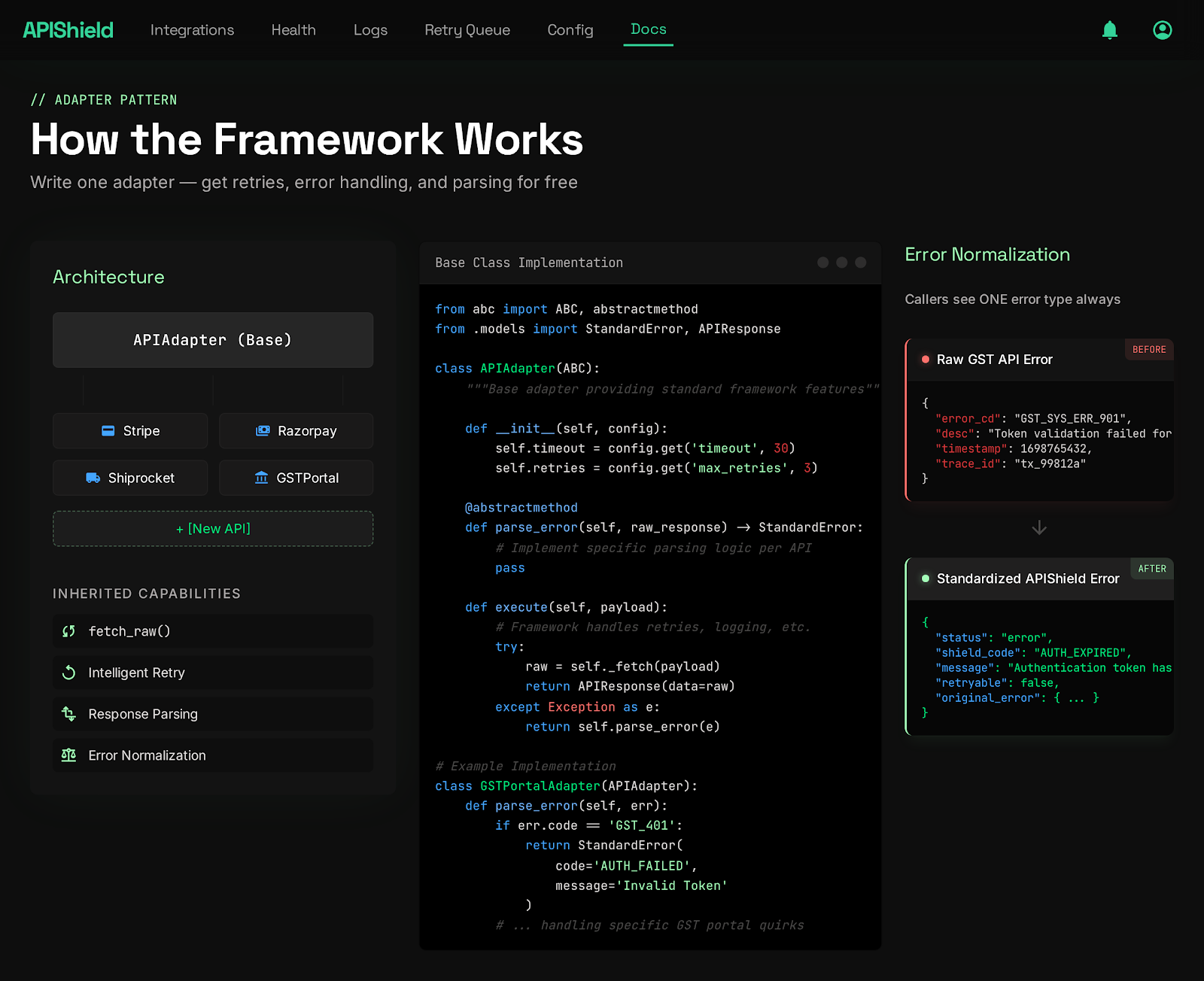
01/02
← → NAVIGATE_SYSTEM
// the problem
What Was Broken
- External API integrations were consistently built from scratch, leading to sprawling, fragile codebases that were incredibly difficult to maintain. Centralized the integration logic into a unified framework, instantly eliminating thousands of lines of redundant boilerplate.
- Retry logic was implemented haphazardly; some integrations lacked it entirely, while others lacked jitter, causing massive thundering herd problems during recovery. Engineered a robust, centralized exponential backoff mechanism that protects downstream services automatically.
- JSON and XML APIs were handled through completely disparate code paths, increasing cognitive load for developers building new features. Abstracted the parsing logic so the application code always interacts with a uniform, normalized dictionary structure.
- Production debugging required reverse-engineering unique legacy code under pressure during active incidents. Standardized the error handling so that every integration raises a predictable, strictly typed internal exception, slashing diagnostic time.
// required fix
- Adding a new API target was a labor-intensive process requiring bespoke error handling and parsing logic. The goal was to build a framework where developers only need to implement a single data-fetching method to deploy a robust integration.
- The system was highly vulnerable to cascading failures when external APIs degraded or timed out. The task was to implement centralized, intelligent retry mechanics that apply to every integration automatically.
- The core application was tightly coupled to the specific error formats of dozens of different external providers. The objective was to engineer an abstraction layer that catches external errors and normalizes them into a single, predictable internal format.
- Handling both XML and JSON formats natively required maintaining divergent code paths. The task demanded a unified parsing engine that transparently converts XML payloads into standard dictionaries, simplifying downstream processing.
// solution
How It Was Built
The solution was engineered around the Abstract Base Class (ABC) pattern in Python, defining a strict contract for all API integrations. The base class encapsulates all the heavy lifting: the exponential backoff decorators, the robust error catching, and the automatic parsing of both JSON and XML responses. Concrete adapter classes inherit from this base and are only responsible for implementing a single `fetch_raw()` method. By standardizing the network layer, all API errors (ranging from 4xx client errors to 5xx server timeouts) are aggressively caught and normalized into a unified internal exception type, completely shielding the application logic from external complexities.
Adapter Base Class
- The fundamental architectural flaw in the legacy codebase was the lack of separation between network execution and business logic.
- 📄 integrations/base.py
Retry + Error Normalization
- Without standardized retries, transient network blips often resulted in hard application failures.
Adapter Base Class
The fundamental architectural flaw in the legacy codebase was the lack of separation between network execution and business logic. To resolve this, a strict Adapter Base Class was implemented. This abstract class defines the comprehensive integration contract, handling authentication injection, network execution, parsing, and normalization. Concrete implementations for specific external APIs only need to override a single method: `fetch_raw()`. This completely eliminated the boilerplate code that developers previously copied and pasted. By forcing all integrations through this single chokepoint, it became possible to globally enforce security policies, logging standards, and timeout thresholds without touching the individual integration files. This structural change drastically improved maintainability and reduced the surface area for bugs.
integrations/base.py
python
class APIAdapter(ABC):
    @abstractmethod
    def fetch_raw(self, endpoint: str) -> Response: ...

    def fetch(self, endpoint: str) -> dict:
        raw = self._retry(self.fetch_raw, endpoint)
        return self._normalize(self._parse(raw))

    @retry(attempts=3, backoff=2, jitter=True)
    def _retry(self, fn, *args): return fn(*args)

    def _parse(self, r: Response) -> dict:
        if 'xml' in r.headers.get('Content-Type',''):
            return xmltodict.parse(r.text)
return r.json()Retry + Error Normalization
Without standardized retries, transient network blips often resulted in hard application failures. The solution was to implement a robust, centralized retry mechanism directly within the base class using decorators. The logic utilizes exponential backoff—meaning the delay between retries increases multiplicatively—combined with randomized jitter. This jitter is crucial; if an external API goes down and a thousand internal processes immediately queue up to retry, they will instantly crash the API again the second it recovers (the 'thundering herd' problem). The jitter staggers these retries randomly across a window, ensuring graceful degradation and recovery. This level of sophisticated resilience was instantly inherited by every integration built on the framework.
// results
What Changed
The framework drastically accelerated development velocity; what previously took days of writing custom integration logic was reduced to a few hours of configuring a new adapter. The structural consistency provided by the base class ensured that every integration inherited enterprise-grade error handling and intelligent retries instantly. Production debugging times plummeted because the integration layer behaved predictably across the entire platform. The most significant impact was that the engineering team stopped fearing external dependencies, knowing the framework would gracefully handle transient failures.
Integration implementation time
1 day (custom per-API)
→
0
~4× faster
Error handling consistency
Inconsistent, per-API
→
0
Standardized
Production debugging time
Hours (one-off legacy code)
→
0
Predictable
"Every integration gets retries, normalization, and consistent error handling for free. The copy-paste fragility is gone."