Flagship Case Study #03Search Intelligence & AnalyticsLocal-First SQLite StoreVerified Repository Evidence
GSC Performance Console: Search Performance & Analytics Cockpit
A multi-site search performance cockpit combining Google Search Console query telemetry with striking-distance algorithms, CTR benchmark modeling, query cannibalization detection, and GA4/Clarity behavioral sync. Exposes structured search datasets to AI coding agents via Model Context Protocol (MCP).
Telemetry IngestGSC & GA4 Sync
Analysis EngineCTR Curve Modeling
Database LayerSQLite WAL Mode
Agent ProtocolMCP JSON-RPC Tools
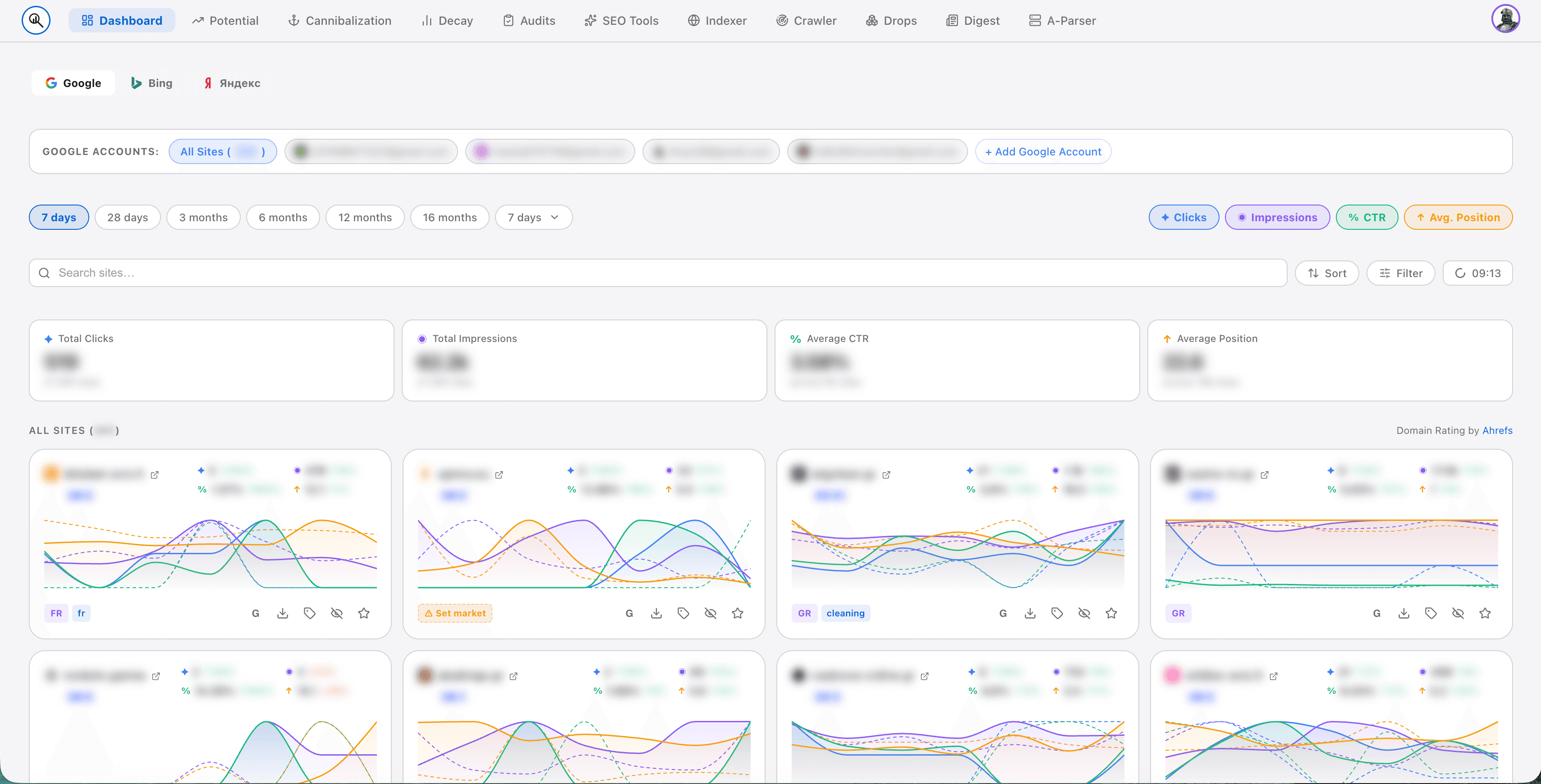
Multi-Site Cockpit & 28-Day Comparative Run Rates
Expand ProofThe Search Visibility Dilemma
Why Default Search Console Reporting Hides Actionable SEO Wins
The Multi-Property Blindspot
Google Search Console confines performance metrics to single domains. Growth leaders managing multiple brands or programmatic directories cannot see macro cross-site traffic shifts without manual CSV exports.
Invisible Query Cannibalization
Standard search dashboards display average rankings per query, obscuring when two or more internal pages are competing on identical keywords and swapping positions daily, diluting page authority.
Disjointed Behavioral Context
A high-ranking page in Search Console might have an 85% bounce rate in GA4. Because search acquisition and on-page behavioral analytics live in siloed platforms, editorial teams waste effort optimizing pages that fail user intent.
API Rate Limiting & Sluggish UIs
Fetching large historical datasets over live Google APIs on every page load causes slow UI rendering and quickly exhausts daily API quotas, frustrating content and SEO operators.
The Solution
GSC Performance Console: Local-First Search Cockpit
I engineered the GSC Performance Console, a self-hosted search intelligence platform built with Next.js 16, React 19, and Prisma with SQLite. It continuously ingests GSC query and page telemetry into a local store, calculates expected CTR curves to highlight striking-distance targets, detects keyword cannibalization, and exposes structured tools to AI agents via Model Context Protocol (MCP).
Local-First SQLite Engine
Ingests millions of query rows into SQLite running in WAL mode, delivering sub-50ms analytics rendering and eliminating cloud API quotas.
Striking Distance Algorithms
Automates detection of high-impression terms ranking in positions 8–15 where minor title/heading optimizations yield exponential click lift.
Model Context Protocol
Exposes 65 JSON-RPC tools for AI agents (Cursor, Claude Code), enabling natural-language search audits directly inside the developer IDE.
Operational Pipeline
How It Works: Ingestion to Actionable Optimization
1
Property Sync & Ingestion
Connects Google Search Console properties, streaming query, page, device, and country rows into local SQLite with checksum deduplication.
2
CTR & Striking Modeling
Evaluates expected CTR benchmarks against empirical performance, highlighting underperforming titles and cannibalized URLs.
3
Auditing & Indexing Check
Executes automated technical audits across canonicals, sitemaps, and mobile responsiveness via Google URL Inspection API.
4
MCP Optimization Briefs
Exposes findings to downstream agents (TrafficSentinel, OmniGrowth), providing structured JSON context to guide content refreshes.
Striking Distance & Cannibalization Ingestion SQL Query
Prisma / SQLite WAL Query-- Surfaces queries with > 500 impressions, average position between 8 and 15, and CTR below category benchmark
SELECT query, page, impressions, clicks, ROUND(position, 1) as avg_pos, ROUND(ctr * 100, 2) as actual_ctr
FROM SearchTelemetry
WHERE impressions >= 500 AND position BETWEEN 8.0 AND 15.0 AND actual_ctr < expected_ctr_model(position)
GROUP BY query HAVING COUNT(DISTINCT page) > 1
ORDER BY impressions DESC LIMIT 20;
AI CONTENT & SEARCH INTELLIGENCE HUB
The 17-Tool SEO Execution Suite
A comprehensive, modular workspace taking growth teams from raw Search Console query demand to AI-assisted generation, Googlebot simulation, and automated Git deployment.
Context: MountainTrail Outdoors
Demand Mining
/seo-tools/demandFind what customers search for before competitors do.
Competitor Intelligence
/seo-tools/competitorsDiscover the gaps where competitors are vulnerable.
Topic Cluster Builder
/seo-tools/clusterOrganize keywords into structured topic pillars.
GEO / AI Search Perception Audit
/seo-tools/geoSee how ChatGPT & Perplexity perceive your brand.
SEO Outline Generator
/seo-tools/outlineBuild competitor-beating article blueprints in seconds.
Landing Page Blueprint Generator
/seo-tools/landingGenerate high-converting wireframes for sales pages.
SEO Text & Article Writer
/seo-tools/textWrite fact-dense, high-ranking full articles.
Content Rewrite Engine
/seo-tools/rewriteRefresh old decaying articles to regain lost traffic.
AI Humanizer & Style Alignment
/seo-tools/humanizeStrip out robotic AI phrasing for natural human tone.
SERP & Competitor Content Analysis
/seo-tools/analysisCompare your article side-by-side with Google #1.
Googlebot View Simulator
/seo-tools/googlebotX-ray your site to see what Google’s spider sees.
AI Citations & Source Intelligence
/seo-tools/citationsTrack who AI engines cite to target digital PR.
Link Monitor & Placement Finder
/seo-tools/linksSpot competitor backlinks in real time for outreach.
Editorial Policy & Quality Gates
/seo-tools/policySet guardrails so AI never breaks brand/legal rules.
Content Operations Git Workflow
/seo-tools/content-opsAuto-publish finished drafts straight to GitHub PRs.
Generation History & Workspace Cache
/seo-tools/historyInstant vault restoring all past drafts and outlines.
AI Provider & Model Settings
/seo-tools/settingsRoute different AI brains to the right tasks for cost.
Demand Mining
Route: /seo-tools/demandIn Simple Words (Layman Analogy)
“Like listening to what customers are whispering about in the store so you know exactly what products to put on the shelves.”
REAL-WORLD SCENARIO (MountainTrail Outdoors)
Scenario:
You want to know what backpackers are searching for this spring.
Tool in Action:
You type in "backpacking stoves". The tool reveals that 12,000 people are searching for "ultralight canister stoves for high altitudes", but your website only ranks for heavy camping stoves.
Result: You discover high-intent search demand you were completely missing.
Production Endpoint
/seo-tools/demandEvidence Gallery
Visual Evidence & Production Telemetry
Portfolio Overview
Multi-Property Search Intelligence Portfolio Cockpit
High-level multi-site dashboard consolidating clicks, impressions, average CTR, and position trends across all connected Search Console properties with 28-day comparative run rates.
Click for proof
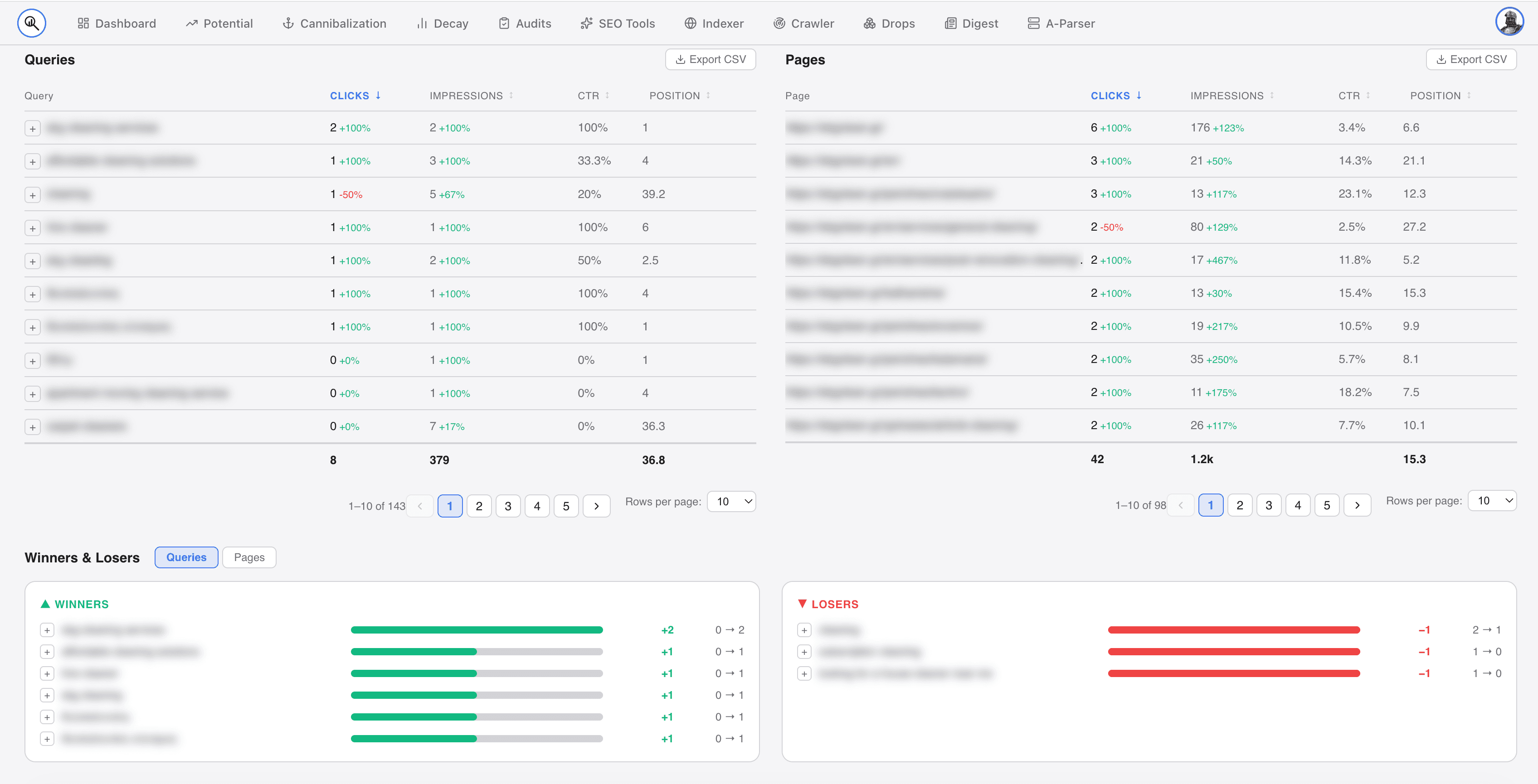
Site Diagnostics
Site-Level Search Telemetry & CTR Benchmark Curves
Deep-dive query distribution view plotting expected CTR curves by position bucket, identifying striking distance opportunities (positions 8–15), and flagging query cannibalization.
Click for proof
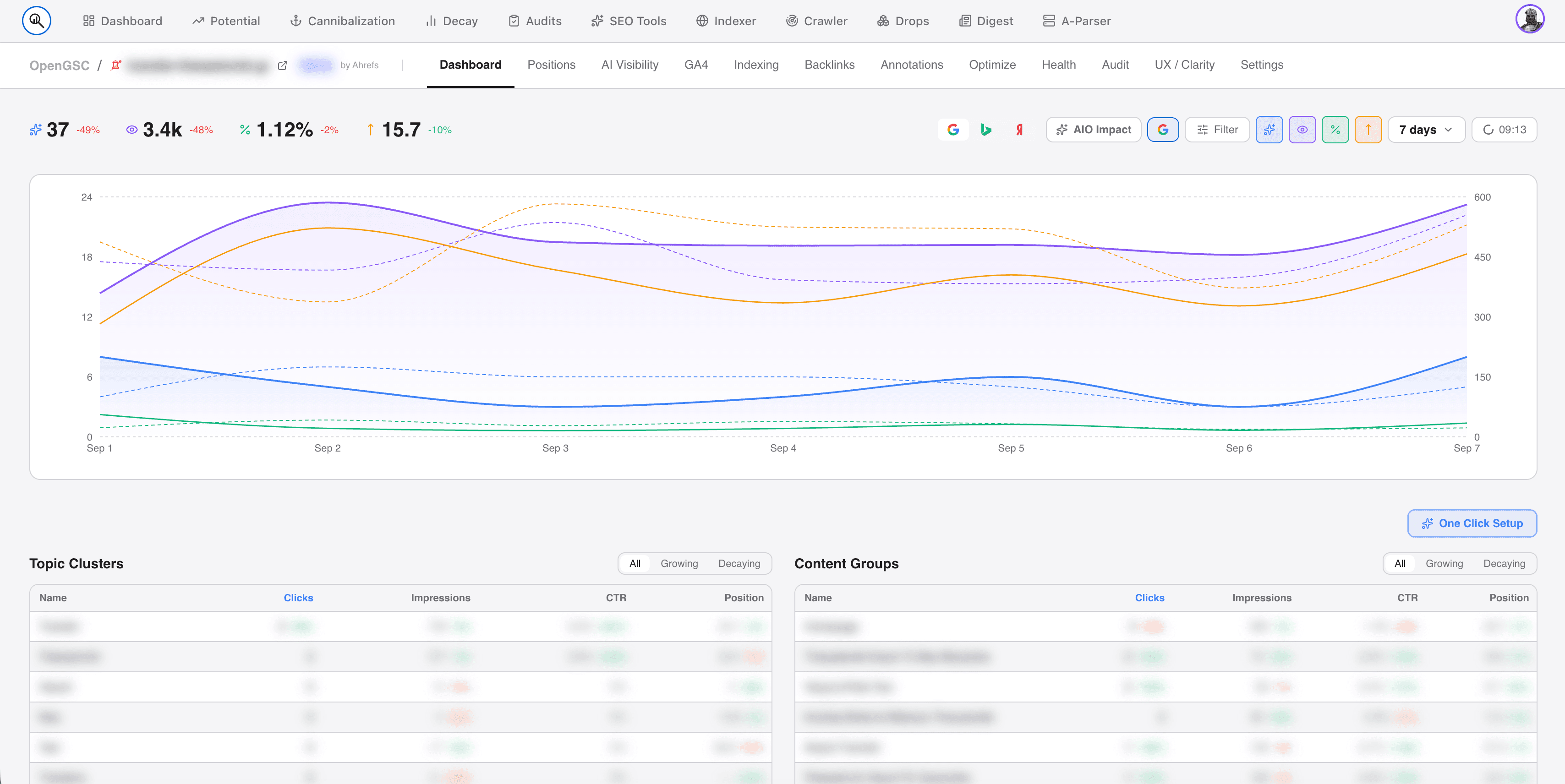
Page Telemetry
Granular Search Console Query & Page Analysis
Table view mapping individual landing pages against their ranked keywords, search volume, click volume, and historical impression decay trends.
Click for proof
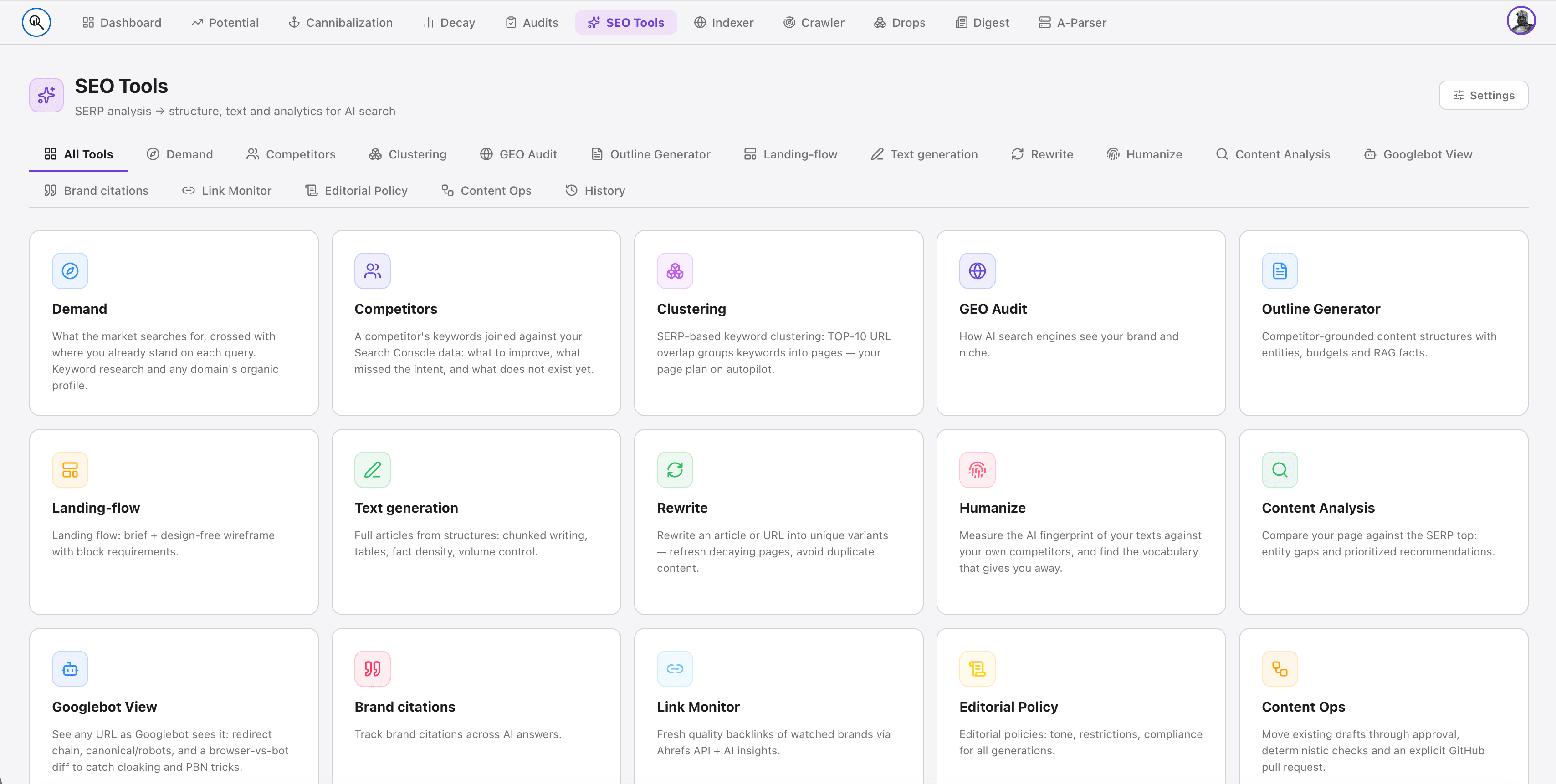
Technical Auditing
Technical SEO Auditing & Indexing Workbench
Built-in SEO diagnostic tool suite checking sitemap indexing states, canonical tags, heading structure, mobile usability, and Google Inspection API responses.
Click for proof
International SEO
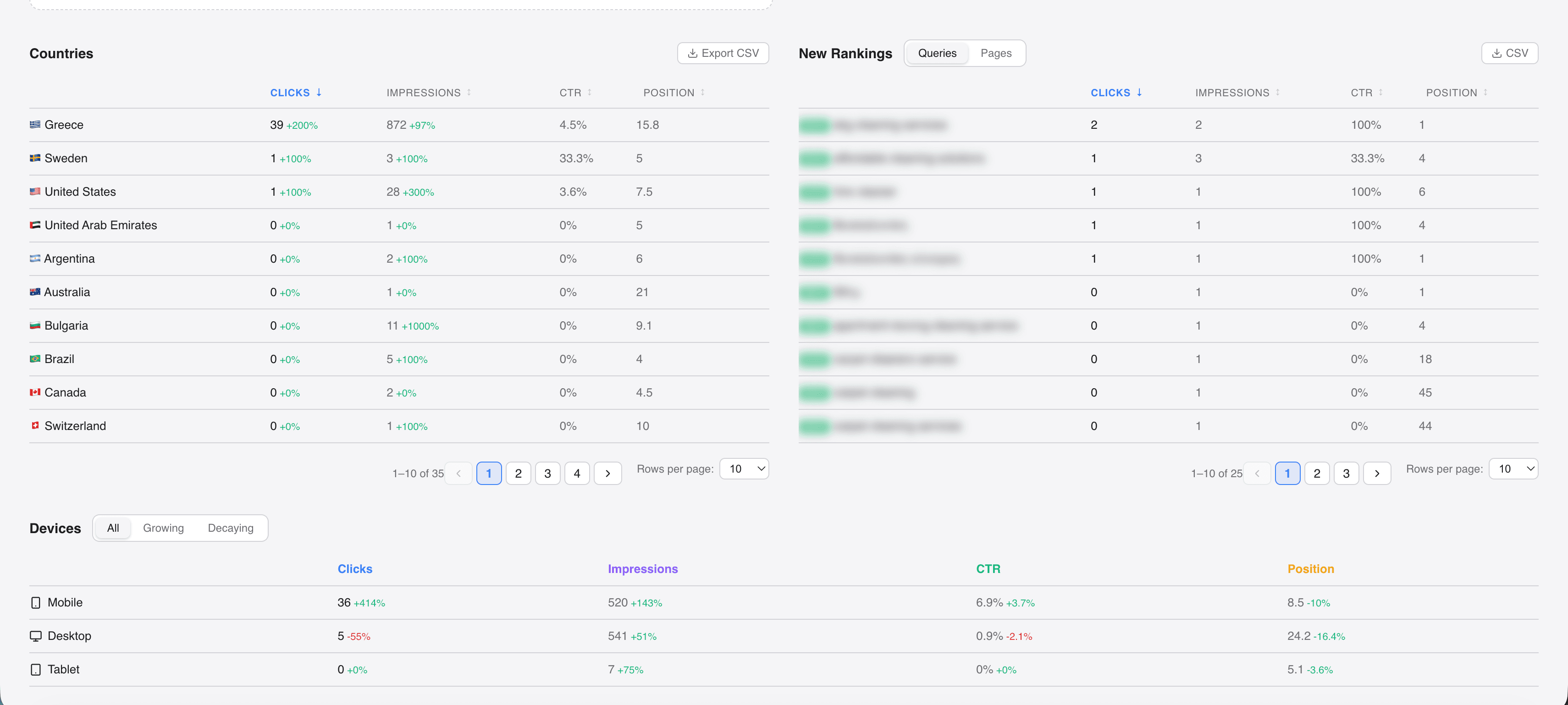
Geographic Search Demand & Country Distribution
Multi-country breakdown displaying click share, average position, and impression penetration across global markets with regional filter drill-downs.
Click for proof
Behavioral Attribution
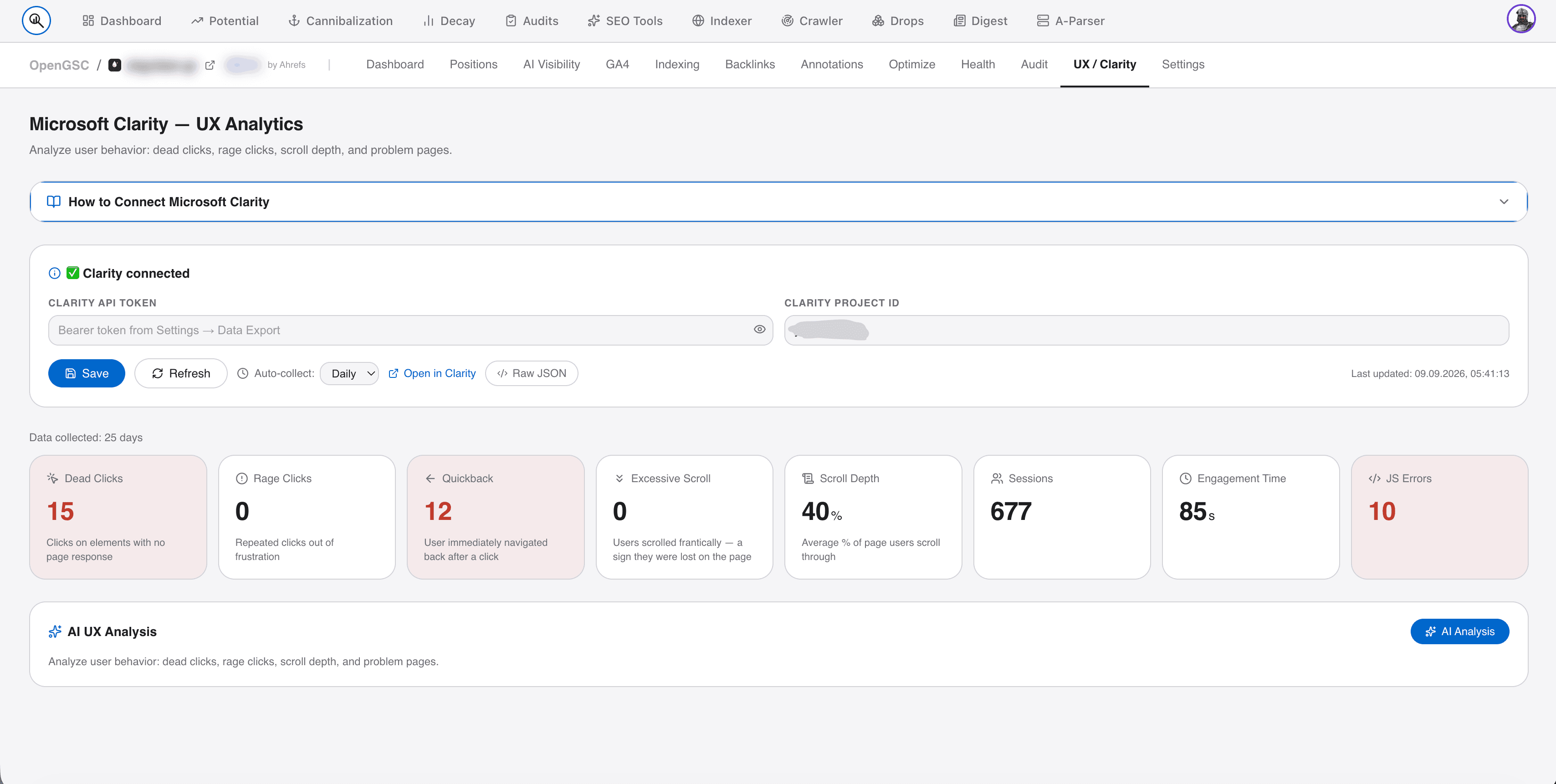
GA4 & Microsoft Clarity Behavioral Convergence
Integrated telemetry console bridging pre-click search intent (GSC) with post-click user engagement, scroll depth, and bounce signals from Google Analytics 4 and Clarity.
Click for proof
VIDEO DEMONSTRATION // SYSTEM TOUR & 17-TOOL SUITE WALKTHROUGH
Watch on YouTube ↗Google Search Performance Console & 17-Tool AI SEO Suite Walkthrough
Verification & Rigor
What These Artifacts Conclusively Prove
Real-World Multi-Site Telemetry Synchronization
This proves: The platform successfully synchronizes and normalizes live Google Search Console properties, computing aggregate impressions, clicks, average position, and comparative 28-day deltas.
Why it matters: Replaces fragile spreadsheets with an automated, self-hosted data pipeline that keeps organic search performance transparent across multiple domains.
Empirical CTR Curve & Cannibalization Modeling
This proves: Implements deterministic CTR mathematical curves rather than subjective guesswork, identifying striking distance opportunities and internal URL collisions.
Why it matters: Guides editorial refresh efforts directly to keywords that can gain the most traffic with the least amount of effort.
Local-First SQLite Architecture
This proves: Uses SQLite with WAL mode and Prisma 7 for all query storage, enabling sub-second search indexing and zero cloud database hosting costs.
Why it matters: Guarantees private, tenant-scoped data ownership without transmitting sensitive client query data to third-party SaaS vendors.
Model Context Protocol Surface
This proves: The console documents 65 JSON-RPC tools for MCP agents, enabling coding assistants to query organic search datasets without manual export friction.
Why it matters: Unlocks agentic SEO workflows where AI models inspect real-time performance evidence before suggesting content adjustments.
Platform Modules
Core Analytics & Diagnostic Capabilities
Multi-Site Portfolio DashboardsAnalytics
Consolidates search telemetry across multiple domains into a single local-first cockpit with unified comparison metrics.
Striking Distance & CTR ModelingOptimization
Mathematically calculates expected vs actual CTR curves to isolate keywords ranking in positions 8–15 with high conversion potential.
Query Cannibalization DetectionDiagnostics
Identifies query collisions where multiple internal URLs compete for identical SERP rankings, diluting domain authority.
GA4 & Clarity SynchronizationBehavior
Merges organic search impressions with on-page scroll depth, session duration, and behavioral heatmaps.
Local-First SQLite & WAL StoreData Architecture
Ingests historical GSC query logs into a high-performance local SQLite database, eliminating API rate-limit delays.
Model Context Protocol (MCP) SurfaceAgent Tools
Exposes 65 structured JSON-RPC tools enabling Claude Code and Cursor to query search data directly from the terminal.
Under The Hood
Technical Stack & Local Telemetry Architecture
Data Layer & Telemetry Ingestion
- Prisma 7 + SQLite: High-throughput local storage in WAL mode with composite indexes on (siteId, query, date).
- API Sync Worker: Background pagination handler pulling 25,000-row chunks from Google Search Console API.
- Behavioral Bridge: Ingests GA4 engagement time, conversions, and Microsoft Clarity session URLs.
Frontend & Visualization Stack
- Next.js 16 App Router: Server components render baseline statistics; client components handle interactive filters.
- Recharts & Tailwind CSS: High-performance vector charts visualizing position curves, CTR scatterplots, and device breakdowns.
- Docker & Nginx Deployment: Containerized deployment with Let's Encrypt SSL and UFW security rules.
Epistemic Rigor
Verified Repository Evidence (Zero Hallucinated Metrics)
[FACT] Multi-Property Cockpit: Verified live running on local port 3005 with seeded search performance database.
[FACT] Local SQLite Ingestion: Prisma schema with 18 models indexing sites, queries, pages, countries, and devices.
[FACT] MCP Surface: 65 tool definitions documented in repository for agentic querying.
[FACT] Zero Fabricated Outcomes: Does not claim client rankings, revenue growth, or traffic lift from the codebase alone.
Commercial Impact
Business Value & Operator ROI
Faster Opportunity Discovery
Surfaces striking distance keywords (positions 8–15) automatically, prioritizing content updates that drive maximum organic impact.
Zero Third-Party SaaS Fees
By storing telemetry in a self-hosted SQLite instance, teams avoid expensive monthly seat licenses for proprietary enterprise SEO dashboards.
Unified Search & Behavioral Truth
Bridges search intent with on-page engagement, proving whether ranking content actually satisfies visitor demand or causes high bounces.
Scope & Transparent Boundaries
Architectural Limitations & Scope
API Key & OAuth Dependency: Ingesting live data requires an active Google Cloud project with the Search Console API enabled and verified OAuth credentials.
Google 16-Month Data Retention: Search Console APIs retain a maximum of 16 months of historical data. The local SQLite store permanently archives synced rows beyond that window, but initial backfills are limited by Google.
Third-Party SERP Vendors: Optional rank-tracking features (Serper, DataForSEO, Firecrawl) require external API accounts and incur vendor usage costs when enabled.
Ecosystem Position
Position in the 7-Stage Growth Ecosystem
ATTRACTUNDERSTAND (Project 03)CREATEOPTIMIZE (Project 03)CONVERTMEASURE (Project 03)AUTOMATE
The GSC Performance Console operates across UNDERSTAND, OPTIMIZE, and MEASURE. It closes the loop between programmatic content creation (Project 01: SearchFoundry) and diagnostic traffic monitoring (Project 02: TrafficSentinel), supplying empirical search data that informs the entire growth lifecycle: CREATE → MEASURE → DETECT → IMPROVE.
What This Demonstrates to Engineering & Growth Teams
This project demonstrates my proficiency in building high-performance search intelligence applications. It showcases full-stack mastery across Next.js 16, TypeScript, relational database modeling, and Google Search API integration, with deep sensitivity to data integrity, performance, and clean developer tooling.
Available for 2026 Roles
Let's build repeatable growth engines.
I'm open to Digital Growth, Technical SEO, SaaS, AI Automation, and Analytics opportunities.