SEO & GrowthOriginal Flagship SystemSynthetic Demo Scenario
Programmatic SEO Content Engine
Automated search-intent → structured content → pre-publish validation → internal-linking pipeline for scalable organic growth.
89/100SEO Quality Score
6-StageAutomated Pipeline
24 ElementsModular Registry
100% ValidSchema.org JSON-LD
Executive Summary & Project Specifications
The Core Problem
Manual SEO production fails to scale. Teams create duplicate keyword targets (cannibalization), publish flat unstructured AI prose that bounces readers, and forget internal linking.
The Engineering Solution
A relational content operations platform that manages topics in PostgreSQL, enforces a 24-element modular block layout, runs pre-publish SEO scoring, and injects mesh internal links.
Verified Stack
Next.js 16 (App Router), React 19, TypeScript, PostgreSQL 16, Prisma ORM, Next.js ISR (Incremental Static Regeneration), Schema.org JSON-LD microdata.
OPERATIONAL FRICTION // WHY SCALE BREAKS SEO
Manual Content Workflows vs. SearchFoundry Engine
BEFORE: UNGOVERNED SEO CONTENT
- ✕Keyword Cannibalization: Writers target overlapping queries, competing against their own domain on Google.
- ✕Flat AI Text: Raw LLM scripts output monotonous text blocks with zero comparison tables, checklists, or FAQs.
- ✕Orphan Pages: Articles are published without bidirectional internal links, stranding PageRank.
- ✕Missing Technical SEO: Canonical tags, Schema microdata, and OpenGraph tags are manually copy-pasted or omitted.
AFTER: SEARCHFOUNDRY ENGINE
- ✓Relational Topic Registry: Unique query & slug indexing in PostgreSQL blocks duplicate targeting.
- ✓24 Modular Elements: Deterministic injection of comparison matrices, checklists, and Schema.org FAQs.
- ✓Automated Link Mesh: Enforces minimum 3 contextual inbound links per post from high-equity pillar pages.
- ✓Pre-Publish QA Gate: 89/100 threshold audit checking keyword density, schema syntax, and depth before deploy.
OPERATING SYSTEM // 6-STAGE PIPELINE
Click any stage to inspect detailsFrom Search Intent to Validated Edge Delivery
STAGE 01 // INGEST
Tech: GSC API / CSV • PostgreSQL Topic RegistrySearch Data: Opportunity Ingestion
Ingests target search queries, intent classifications, search volume, and keyword difficulty. Validates against existing published registry to prevent keyword cannibalization.
PRODUCT SHOWCASE // LIVE PRODUCTION CAPTURES
6 Production ViewsSearchFoundry Interfaces & Video Walkthrough
Real application screens captured from the local SearchFoundry workspace configured for the MountainTrail scenario. Click any screen to inspect full resolution.
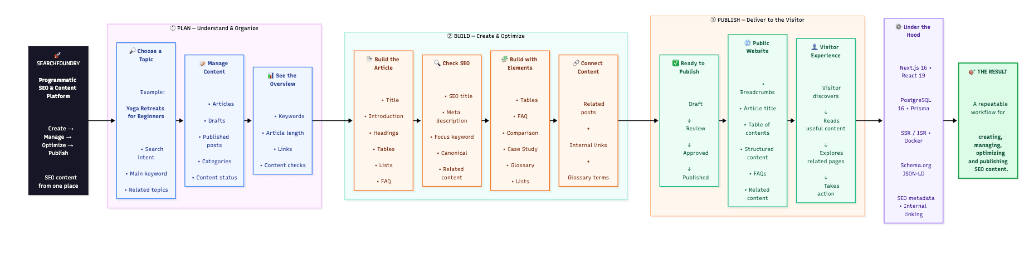
SYSTEM FLOWCHART // FULL RESOLUTION
Click to Enlarge
SearchFoundry End-to-End Architecture FlowchartClick to view in Lightbox →

OVERVIEW
Enlarge
Content Operations Dashboard
Centralized overview tracking 5 total posts, published articles, drafts, queue backlog, and 4 taxonomy category clusters.

GOVERNANCE
Enlarge
Topic Management Pipeline
10 target search opportunities progressing deterministically through Pending (5), Generated (1), Approved (1), and Published (3).
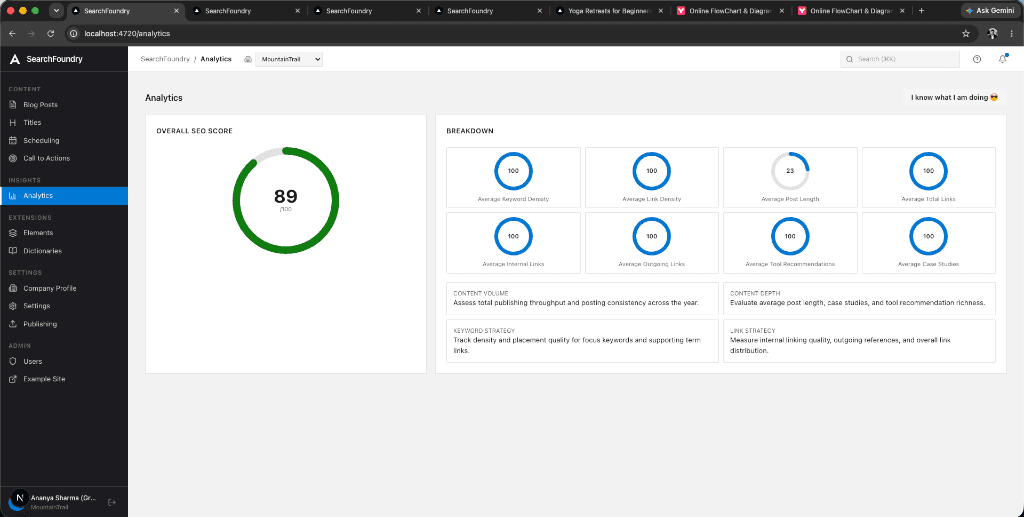
VALIDATION
Enlarge
Automated SEO Quality Inspector
Pre-publish quality score (89/100) evaluating keyword density, link density, post length, outgoing references, and schema microdata.

STRUCTURE
Enlarge
24 Modular Content Elements
Configurable element registry enabling modular injection of Tables, FAQs, Checklists, Comparisons, Case Studies, and Pros/Cons.
VIDEO DEMONSTRATION // 2-MINUTE SYSTEM TOUR
Watch on YouTube ↗SearchFoundry System Tour & Workflow Walkthrough
RECRUITER STORY DECKChapter 1 of 8Use ← / → arrow keys
How SearchFoundry Works: 8-Step Story Walkthrough
A step-by-step visual demonstration connecting the operational problem, system diagram, actual UI screenshot, and recruiter explanation.
OPERATIONAL BOTTLENECK
The Real Problem: SEO Content Gets Hard to Manage at Scale
The bottleneck is not writing one article — it is managing dozens of topics without manual chaos.
1 / 8
Story Diagram (Vector SVG)SearchFoundry Language
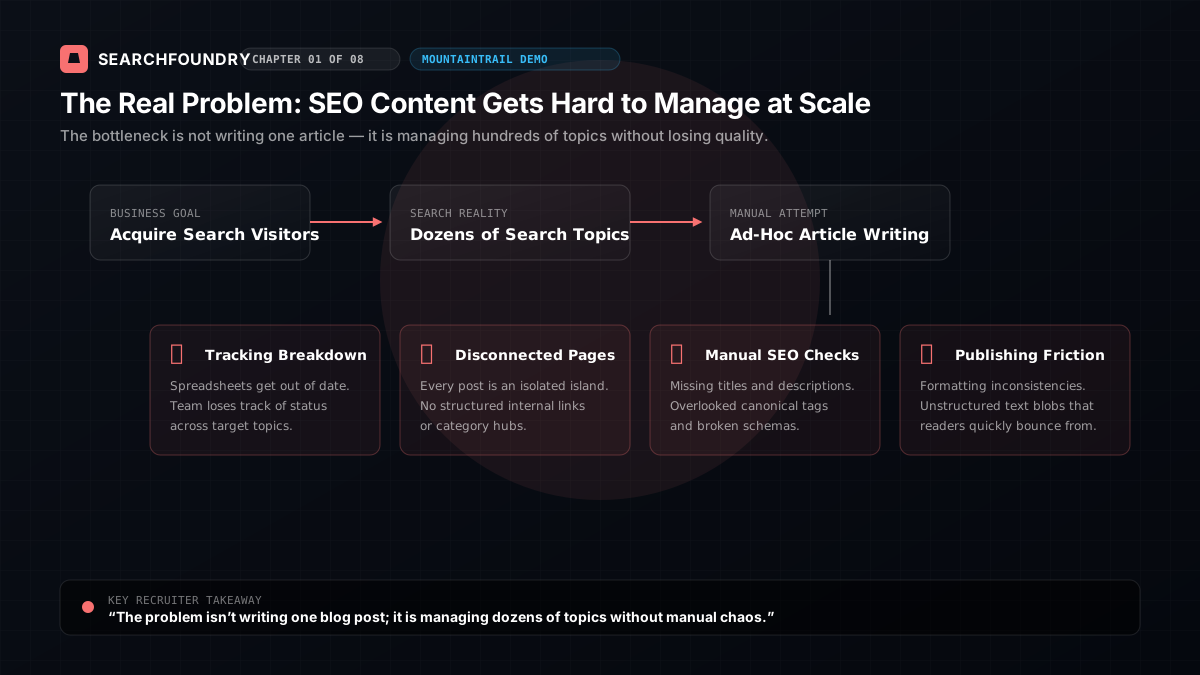
Visualizing the concept for non-technical stakeholders in 5–10 seconds.
Verified Application UIMountainTrail Demo
SearchFoundry Dashboard: Centralized content operations tracking 5 active posts, drafts, and categories for MountainTrail.
INTERVIEW TALKING POINTS // WHAT YOU SAY TO A RECRUITER
“The problem isn’t writing one blog post. The problem starts when a business needs to manage dozens or hundreds of search topics. Someone has to decide what to write, track what has been created, verify SEO metadata, connect related pages, and eventually publish everything. If all of that is handled manually in spreadsheets, the operational process breaks down. That is the exact challenge SearchFoundry is built around.”
THE OPERATIONAL PROBLEM
Manual coordination between writers, spreadsheets, and CMS creates duplicate work, broken link structures, neglected metadata, and publishing bottlenecks.
DEMONSTRATED CAPABILITY
Unified content intelligence dashboard centralizing topic statuses, category assignments, and production pipeline throughput in one workspace.
Sequence: Diagram → Screenshot → Explanation → Real Problem → Result
SYSTEM DESIGN // CONTROL PLANE & DATA GRAPH
Decoupled Technical Architecture
A decoupled architecture separating the editorial control plane from high-speed edge delivery.
1. CONTROL PLANE
Topic pipeline, anti-cannibalization gate, element registry
2. AI COMPOSITION
GPT-5.2 structure model + 24 modular content blocks
3. QUALITY GATE
Pre-publish inspector (89/100 threshold) + link mesh
4. EDGE PUBLISH
Next.js 16 ISR static HTML + Schema.org JSON-LD
FRONTEND
Next.js 16
React 19 • Tailwind CSS • Radix
DATABASE
PostgreSQL 16
Prisma ORM • Relational Schemas
RENDERING
Next.js ISR
Sub-50ms TTFB • Edge Cache
METADATA
Schema.org
Article • FAQPage JSON-LD
TOPICAL CLUSTERS // INTERNAL LINKING GRAPH
Pillar-to-Cluster Mesh Architecture
SearchFoundry enforces strict topical authority relationships to pass PageRank and eliminate orphan articles.
PILLAR: /wellness-travel/ (Parent Hub)
SUB-PILLAR: /yoga-retreats/
SUB-PILLAR: /mindfulness-hikes/
/beginner-retreats
/packing-checklist
/weekend-retreats
/solo-travel-faq
1. Bidirectional MeshChild cluster articles link upward to their parent pillar and horizontally to related sibling topics.
2. Zero Orphan PagesThe pre-publish validator rejects any article that does not have at least 3 inbound internal links.
3. Exact Anchor GovernanceLinks use semantically descriptive anchor text rather than generic “click here” phrases.
VALIDATION GATE // PRE-PUBLISH INSPECTION
89/100 PRE-PUBLISH PASSAutomated 89/100 Quality Score Breakdown
✓ PASSKeyword Density
2.1% (Optimal)✓ PASSInternal Link Density
3 Links (Passed)✓ PASSContent Depth
2,450 Words✓ PASSSchema.org Microdata
100% ValidBLOCK REGISTRY // 24 MODULAR ELEMENTS
Structured Elements over Walls of AI Text
Google rewards high information density. SearchFoundry enforces structured components across 4 functional categories.
CATEGORY A // SUMMARY & LAYOUT
- • Key Takeaways / TL;DR Highlights
- • Executive Summaries & Concept Overviews
- • Definition Cards & Quick Answers
CATEGORY B // COMPARISON & DATA
- • Multi-column Comparison Tables
- • Feature & Pricing Matrices
- • Pros / Cons Evaluation Blocks
CATEGORY C // INTERACTIVE & TRUST
- • Step-by-Step Actionable Checklists
- • Schema.org Validated FAQ Accordions
- • Expert Commentary & Citation Blocks
CATEGORY D // CONVERSION & ACTION
- • Contextual In-Article CTAs
- • Resource Download Prompts
- • Internal Cluster Navigation Links
HIRING MANAGER & RECRUITER CHEATSHEET // INTERVIEW Q&A
4 Core Discussion PointsArchitectural Decisions & Defense
Q1
Why build an engine instead of using a batch AI writing script?
Unconstrained scripts create keyword cannibalization, repetitive outlines, hallucinated claims, and zero relational data integrity. SearchFoundry enforces a relational topic registry in PostgreSQL, a mandatory 4-stage review lifecycle, and pre-publish quality audits before rendering.
✓ Value: Repeatable quality & brand safety over raw volume
Q2
How is keyword cannibalization prevented at scale?
Every article targets a unique search intent cluster stored in PostgreSQL. The pipeline blocks duplicate slug or intent collisions, and programmatically establishes bidirectional internal links to related sibling topics within the cluster to preserve page authority.
✓ Value: Deterministic taxonomy hierarchy & PageRank distribution
Q3
Why Next.js ISR instead of pure SSR or Static Site Generation?
Pure SSG requires full rebuilds as article catalogs grow into thousands. SSR adds TTFB latency on every Googlebot request. Next.js ISR serves pre-rendered static HTML with sub-50ms TTFB while regenerating stale pages in the background when editorial edits occur.
✓ Value: Perfect Core Web Vitals & instant edge delivery
Q4
What is the purpose of the 24 modular content elements?
Monotonous walls of AI text have high bounce rates and fail user intent. Modular elements (Checklists, Comparison Tables, Pros/Cons blocks, Schema FAQs) create structured, high-density layouts that earn Google Rich Snippets and increase reader engagement.
✓ Value: High information density & Schema.org Rich Results
MountainTrail: Yoga Retreats for Beginners
Business Context:MountainTrail is a synthetic travel & wellness brand demonstrating SearchFoundry's capabilities. Growth Manager Ananya Sharma uses the platform to organize search topics around “yoga retreats for beginners” into an editorial pipeline.
Target Query: “yoga retreats for beginners” (Commercial Investigation intent). The platform successfully generates a structured, 2,450-word guide with technical SEO metadata (title tags, canonical URL, and Schema.org JSON-LD microdata) and verified internal links.
* MountainTrail is a synthetic demonstration scenario. Local records are seeded for demonstration purposes. No commercial client metrics are claimed.
An Engineered Approach to Programmatic SEO
Combining relational topic governance, modular LLM generation, automated quality validation, and edge delivery.

Available for 2026 Roles
Let's build repeatable growth engines.
I'm open to Digital Growth, Technical SEO, SaaS, AI Automation, and Analytics opportunities.