Track 2: Digital Growth & SEOAutonomous AI AgentReport-Only Safe Policy
TrafficSentinel AI: SEO Traffic Intelligence & Content Refresh Agent
Automated SEO monitoring workflow that identifies organic traffic declines, investigates SERP competitors and content gaps, and generates decision-ready Markdown refresh briefs.
-19.0%Sitewide Drop Isolated
62% LossIn Top 7 Declining URLs
40–60%Expected Traffic Recovery
22 SkillsDecoupled Agent Stack
Executive Summary & Project Specifications
The Real-World Problem
Publishing content is only half the battle. Over time, rankings decay as competitors refresh articles and search intent drifts. Manual diagnosis takes 3–5 hours per decaying URL.
The Autonomous Solution
A Python agent running a 3-stage loop: Diagnose (>20% drop), Act (SERP authority filter + competitor gap analysis), and Strategize (decision-ready briefs).
Production Technology
Python 3.11, Pydantic data schemas, SerpAPI live search extraction, BeautifulSoup4 DOM parsing, LangChain structured briefs, and flock file-locking safe execution.
DECOUPLED AGENT DESIGN // 22 SPECIALIZED SKILLS
3-Stage Architecture: Diagnose → Act → Strategize
Instead of a monolithic script, TrafficSentinel divides the remediation lifecycle into 3 specialized stages, preventing uncontrolled production changes.
STAGE 1: DIAGNOSE
Telemetry & Anomaly Detection
Continuously ingests Google Search Console data, isolating pages experiencing >20% MoM click drops, CTR loss, or ranking slippage.
Skills: traffic-decay-detector • cannibalization-check
STAGE 2: ACT
Authority Gate & SERP Scraping
Evaluates Domain Rating feasibility (filters unwinnable queries), scrapes competitor DOM heading trees, and drafts surgical refresh briefs.
Skills: serp-authority-mark • competitor-serp-monitor
STAGE 3: STRATEGIZE
Executive Roadmap & Safe Loop
Ranks candidates by ROI priority score, models expected click recovery, and compiles the final executive Markdown report under human review.
Skills: seo-priority-score • seo-growth-loop (report-only)
View Complete 3-Stage Skills Architecture Flowchart
Detailed component breakdown from inputs to decision artifactsEnlarge
LIVE RUN WALKTHROUGH // 90-DAY TELEMETRY DATASET
Step through the 4 execution phasesThe Diagnostic Pipeline in Action
python3 run_demo.py — Stage 01
SCOPE: 47 PAGES | 312 QUERIESAudits rolling 90-day Google Search Console telemetry against previous period (42,300 → 34,260 clicks).
Mechanics: Isolates macro-level traffic drops, average position drift (pos 8.2 to 9.1), and sitewide CTR erosion (14.8% to 12.6%) before checking URL-level decay.
VERIFIED PRODUCTION PROOF // TERMINAL & REPORTS
6 Verified AssetsLive Audit Captures & Flowcharts
Live terminal executions, GSC performance audits, authority check matrices, and system flowcharts. Click any item to inspect in full resolution.
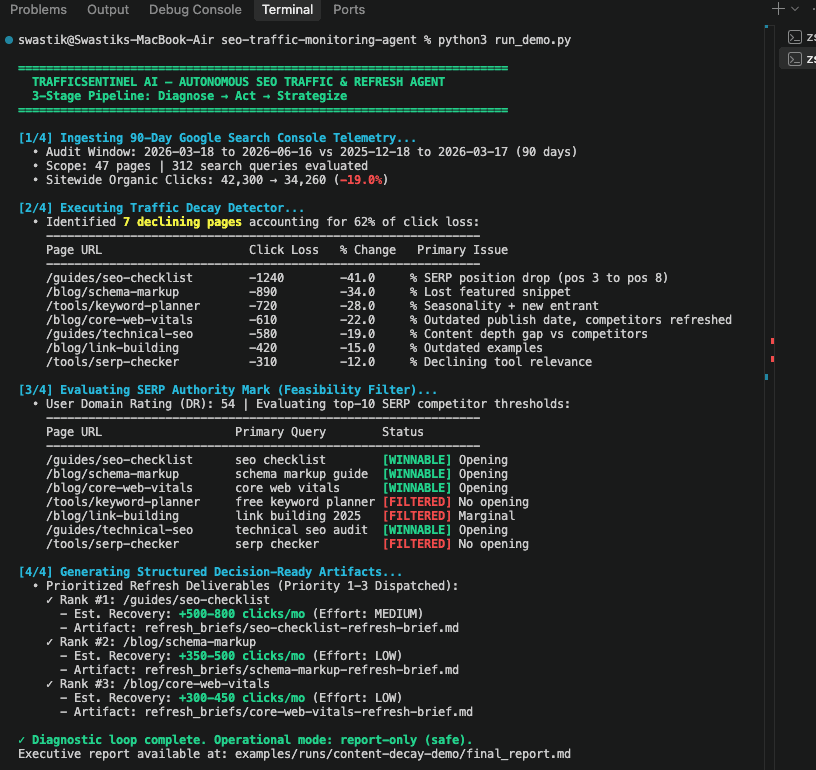
TERMINAL RUN // 4-STEP EXECUTION
Click to Enlarge
Complete Pipeline Execution (python3 run_demo.py)
Isolates 7 pages causing 62% of loss, marks winnable openings, and exports recovery roadmap.
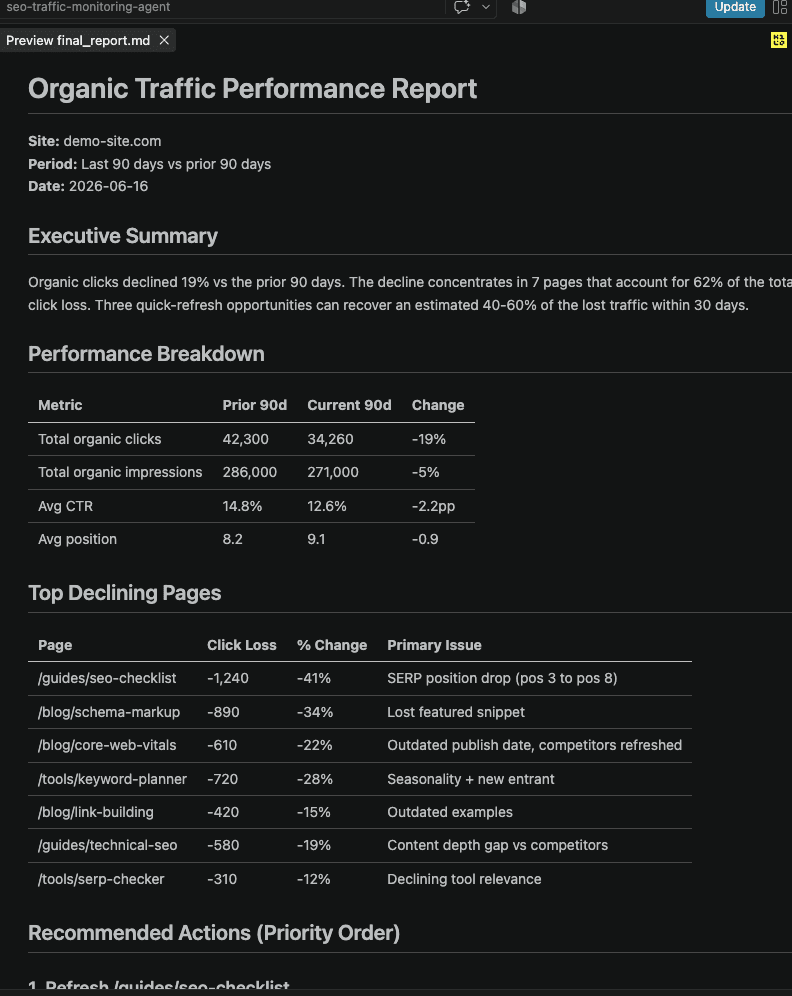
FINAL REPORT
Enlarge
Executive Organic Traffic Report
Rendered final_report.md summarizing sitewide -19% drop, concentrated 7 declining URLs, and prioritized 3-step action recovery roadmap.
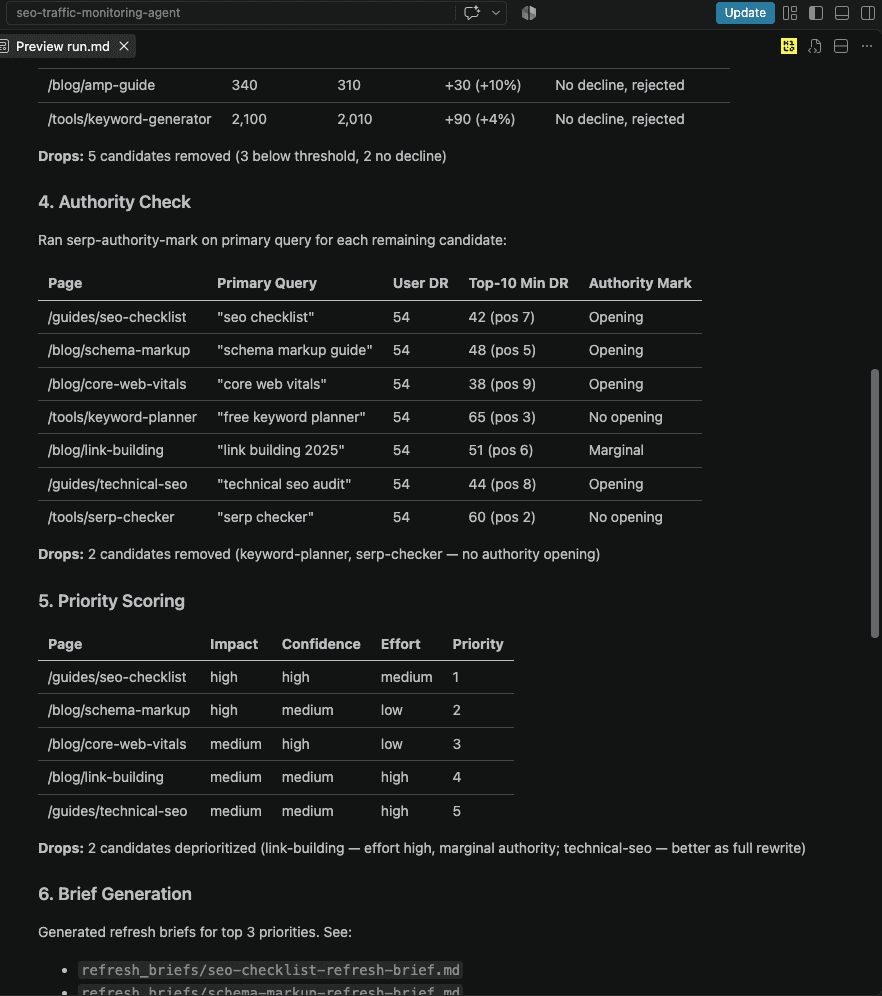
DECISION MATRIX
Enlarge
SERP Authority & Priority Matrix
Evaluates User DR (54) vs Top-10 SERP Min DR. Marks /guides/seo-checklist as [WINNABLE], filters out /tools/keyword-planner (DR 65+ ceiling), and scores ROI priority 1 to 5.
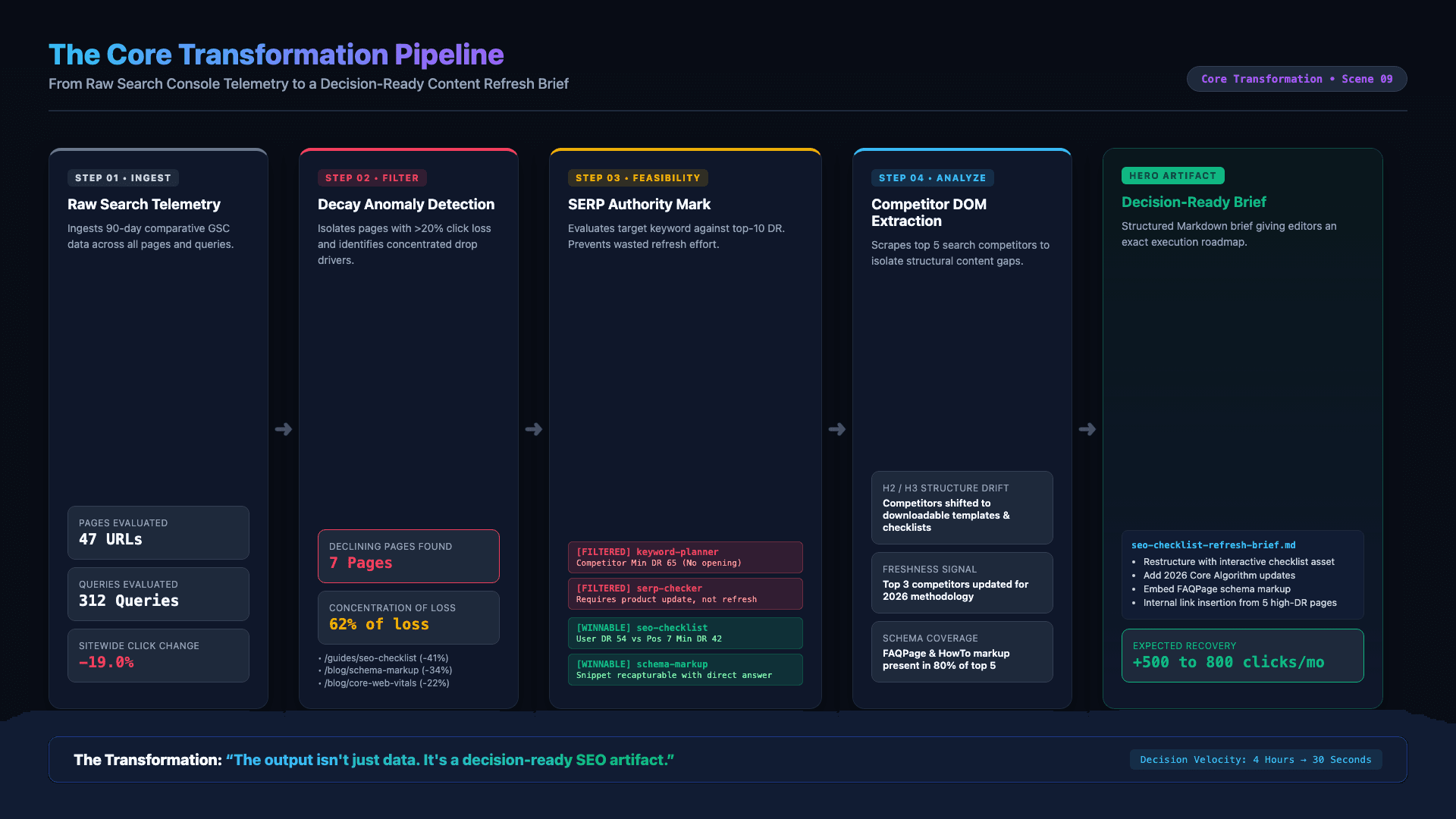
TRANSFORMATION PIPELINE
Enlarge
5-Stage Core Transformation Funnel
Architectural flow showing how 47 raw pages and 312 queries are filtered down to exactly 3 decision-ready refresh briefs with zero human guesswork.
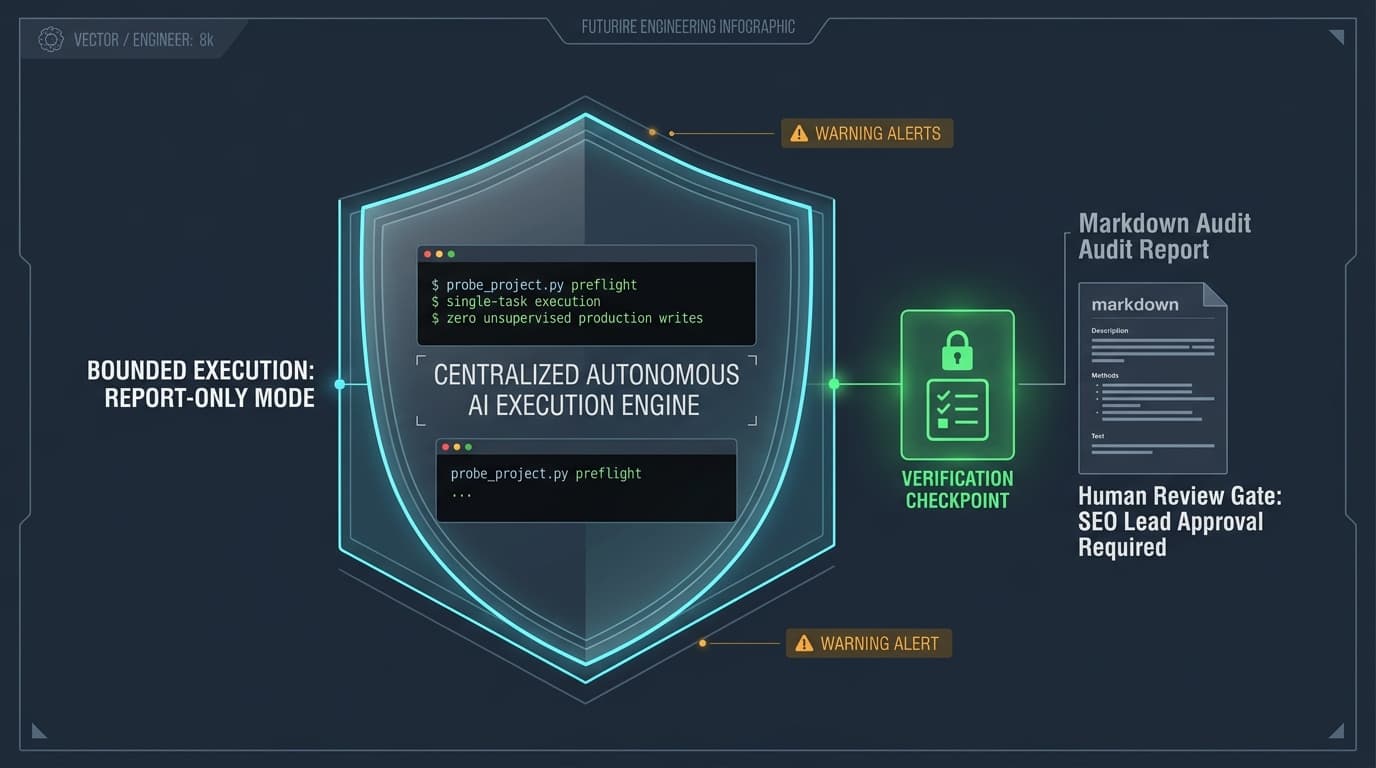
SAFETY ARCHITECTURE
Enlarge
Safe & Bounded Automation Loop
Preflight probe, safe_default_mode: report-only enforcement, flock timeout limits, and human review checkpoint preventing uncontrolled production CMS mutations.
VIDEO DEMONSTRATION // 2-MINUTE SYSTEM TOUR
Watch on YouTube ↗TrafficSentinel Autonomous SERP Diagnostics Walkthrough
ACTIONABLE DELIVERABLES // ACTUAL AGENT BRIEFS
Generated Content Refresh Briefs
Refresh Brief: /guides/seo-checklistPrimary Query: “seo checklist” • Position Drop: pos 3 → 8 (-41%)
Est. Recovery: +500–800 clicks/moSERP Intent Shift: The SERP has shifted from conceptual guides to downloadable execution assets (Notion/Canva checklists) and interactive progress tracking tools.
COMPETITIVE CONTENT GAPS (EXTRACTED VIA BEAUTIFULSOUP):
• Missing downloadable PDF/Notion checklist template (offered by top 3 competitors)
• Missing 2026 Core Web Vitals (INP) audit section
• Outdated references to deprecated Google testing tools
ACTIONABLE REMEDIATIONS TO RESTORE RANK 1:
1. Update Title: “2026 SEO Checklist: Step-by-Step Audit Guide + Downloadable Template”
2. Inject 3 high-equity internal links from /guides/technical-seo and /blog/schema-markup
3. Add Schema.org HowTo & FAQPage JSON-LD microdata
SAFETY & BOUNDARY MODEL // STRICT REPORT-ONLY POLICY
Why Autonomous SEO Agents Require Hard Boundaries
Autonomous agents should never make unmonitored production changes to a live website. A rogue prompt or hallucinated recommendation could break schema microdata, corrupt canonical tags, or introduce sitewide SEO penalties.
1. Preflight Probe
Runs probe_project.py to inspect the surface, detect Git vs CMS environment, and enforce safe_default_mode: “report-only”.
2. Single-Candidate Bound
Bounded execution cycle analyzes exactly 1 priority opportunity per loop run, preventing API token spikes and timeout crashes.
3. Human Review Gate
Outputs decision-ready Markdown artifacts into audit logs. Human SEO directors retain final approval before CMS deployment.
SYSTEM SYNERGY // THE COMPLETE LIFECYCLE
SearchFoundry + TrafficSentinel Closed Growth Loop
How Project 01 and Project 02 combine to create an end-to-end autonomous organic growth engine: Create → Publish → Monitor → Detect → Refresh.
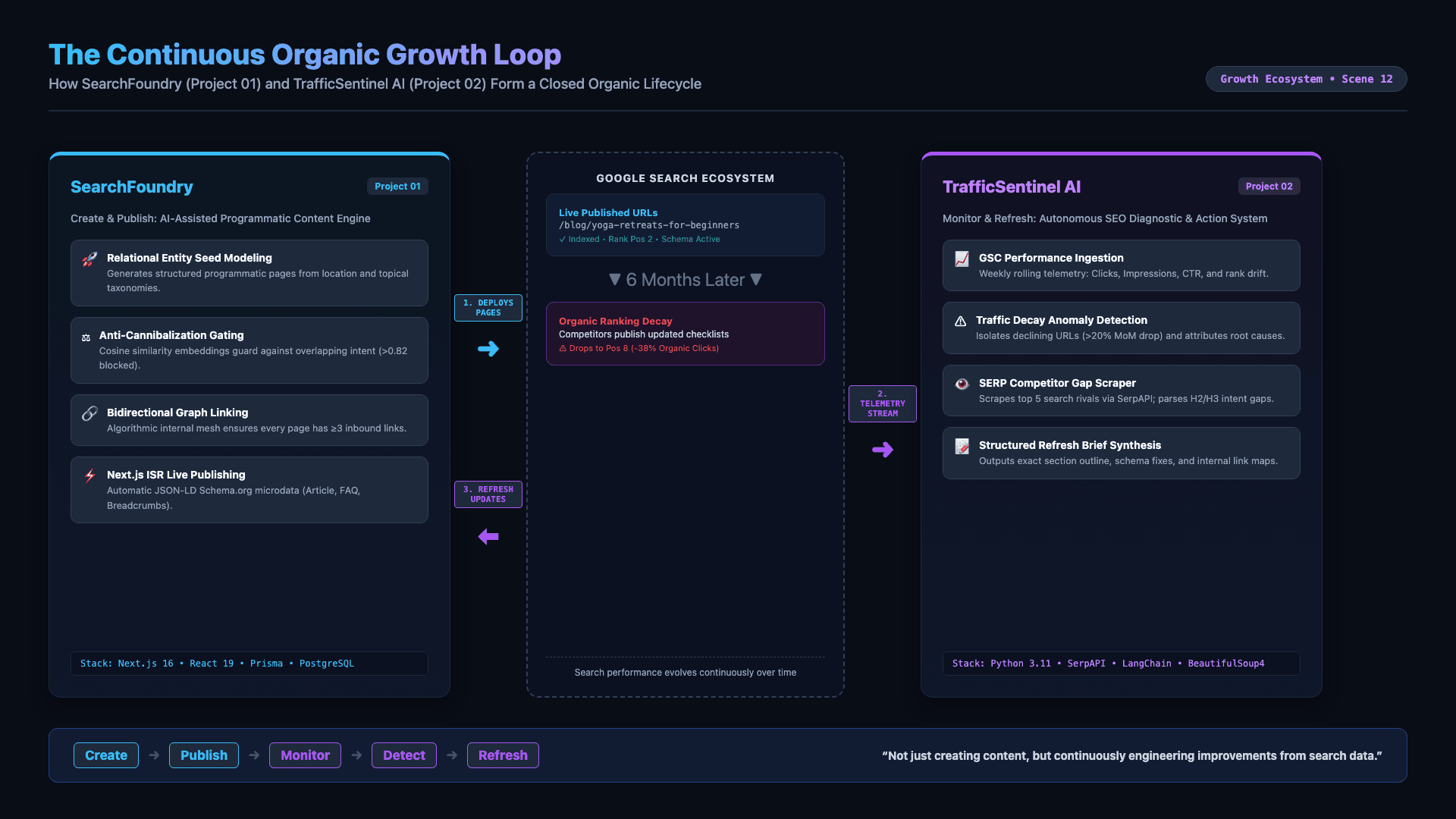
CLOSED GROWTH LOOP // FULL FLOW
Enlarge Diagram
Project 01: SearchFoundry (Create & Publish)Focuses on the creation phase: Topic discovery, anti-cannibalization checks, 24 modular blocks, and Next.js ISR edge publishing.
Project 02: TrafficSentinel AI (Monitor & Refresh)Focuses on post-launch lifecycle: Continuous telemetry monitoring, isolating decay anomalies, SERP authority checks, and automated refresh briefs.
HIRING MANAGER & RECRUITER CHEATSHEET // INTERVIEW Q&A
4 Core Discussion PointsArchitectural Decisions & Defense
Q1
Why build 22 specialized skills instead of one large Python script?
A monolithic script fails when SERP structures drift or API rate limits trigger. Decoupling into discrete skills (traffic-decay-detector, serp-authority-mark, content-refresh-brief) allows each module to be tested independently, cached, and composed into custom workflows.
✓ Value: High modularity, testability, and bounded failure domains
Q2
What is the purpose of the SERP Authority Mark filter?
Most SEO teams waste hundreds of hours refreshing articles targeting keywords they can never win because top-10 competitors have unbeatable Domain Ratings (DR 70+). The Authority Mark checks if the SERP is winnable (DR ≤ 54) before allocating editorial time.
✓ Value: Prevents wasted engineering hours on unwinnable SERPs
Q3
How does the agent distinguish algorithm updates from content decay?
When traffic drops, the agent correlates the exact decline timestamp with documented Google Core and Helpful Content update dates. A sitewide simultaneous drop across multiple clusters indicates an algorithmic shift; a gradual decline in specific URLs indicates competitor content drift.
✓ Value: Root cause accuracy preventing wrong remediation tactics
Q4
Why keep the automation loop strictly “report-only”?
Allowing an LLM agent to directly rewrite production CMS articles without supervision is dangerous. The report-only policy outputs decision-ready Markdown briefs into an auditable ledger, giving human content directors the final sign-off before publishing.
✓ Value: Brand safety, compliance, and strict human review governance
Turning Search Decay into Repeatable Recovery
Autonomous Python agents that monitor search data, filter winnable opportunities, and engineer recovery roadmaps.

Available for 2026 Roles
Let's build repeatable growth engines.
I'm open to Digital Growth, Technical SEO, SaaS, AI Automation, and Analytics opportunities.